Outsourcing isn't valuable just because work leaves the building. The value shows up in daily outcomes: steadier throughput, fewer quality disruptions, and internal teams spending time on work only they can do.
This article covers the practical benefits, the KPIs they touch, the risks of holding onto constrained assembly in-house, and how to evaluate a partner.
Key Takeaways
- Assembly outsourcing hands selected assembly, kitting, packaging, or rework tasks to a specialist.
- Benefits can include lower overhead, experienced labor, tighter quality controls, and flexible capacity.
- Judge the business case on total cost, quality, lead time, and space, not quoted labor rates.
- Clear instructions, traceability, and regular reviews decide whether it works.
What Is Assembly Outsourcing?
Assembly outsourcing means a manufacturer contracts an outside provider to join, prepare, inspect, package, kit, or rework components instead of doing every step with its own people and facility.
Typical tasks include:
- Mechanical joining and subassembly
- Sorting, deburring, and flash removal
- Kitting, labeling, and packaging
- Rework and parts preparation
Manufacturers use it most often in automotive supply, metal stamping, plastic injection molding, die casting, foundry work, product launches, and quality containment.
It differs from full manufacturing outsourcing. A company might outsource one repeatable secondary operation while keeping design, core production, engineering, purchasing, and customer relationships.
It also isn't an automatic replacement for internal manufacturing. The right call depends on volume, complexity, labor availability, space, quality requirements, and what it would cost to build or maintain the capability yourself.
Key Advantages of Assembly Outsourcing
The advantages below are operational outcomes. Treat them as possibilities to test against your own numbers, since results depend on the partner and the controls around the work.
Lower Internal Costs and Better Capacity Use
Outsourcing can reduce the need for dedicated assembly labor, supervision, equipment, training, maintenance, and floor space. Compare the provider's quote with the full internal cost, not just the hourly wage.
BLS puts average manufacturing employer compensation at $49.35 per hour: $32.88 in wages plus $16.47 in benefits. That's an industry average, not your direct-labor rate, but it shows why wage alone understates cost.
Count these on the internal side:
- Overtime and hiring
- Training time pulled from production
- Quality checks and rework
- Idle capacity when demand dips
KPIs affected: cost per unit, labor hours per unit, overtime, floor-space and equipment utilization, headcount. This matters most in high-volume, space-constrained, or short-staffed plants.

Stronger Quality Control and Lower Quality Risk
A capable partner works from documented instructions, dedicated inspection steps, sorting, containment, and traceability. That can beat an overstretched internal process where inspection competes with production.
The payoff is fewer defects, less rework, fewer complaints, and faster response to a suspect-part alert or quality spill. Customer requirements vary, so confirm the exact obligations. GM, for example, replaced GP-12 with Early Production Containment in its customer-specific requirements. That's GM-specific, not a universal rule.
KPIs affected: first-pass yield, defect-escape rate, rework hours, returns, complaint volume, containment response time, on-time release. Automotive suppliers, launch programs, and safety-sensitive parts feel this most.
Flexible Capacity, Faster Throughput, and More Focus
Outsourcing adds labor and capacity without a permanent hire, an equipment purchase, or an expansion. That helps with launches, seasonal peaks, backlogs, surprise quality work, and shifting order volumes.
- Core lines keep running while an outside team handles subassembly, kitting, packaging, deburring, or rework
- Engineers and supervisors spend time on process improvement and customer requirements instead of repetitive tasks
KPIs affected: throughput, lead time, on-time delivery, capacity utilization, backlog, ramp-up time, schedule adherence.

What Happens When Assembly Stays In-House Under Strain
Keeping everything in-house works until staffing, space, equipment, or demand falls out of line with production needs. Deloitte's 2025 survey found 48% of respondents had moderate-to-significant trouble filling production and operations management roles. Pressure like that tends to show up as:
- Rushed or inconsistent work when people split time between core production and secondary tasks
- More errors, rework, and defect escapes when inspection capacity is missing
- Firefighting during complaints, suspect-part alerts, launches, or volume spikes
- Rising costs from overtime, training, idle capacity, equipment, and space
- Assembly knowledge concentrated in a few people, which makes scaling and delegating hard

These are risks to investigate, not guaranteed outcomes. Outsourcing doesn't erase them automatically either.
How to Get the Most Value from Assembly Outsourcing
Outsourcing works when you apply it consistently, measure it against agreed outcomes, and act on what the numbers say. It fails as a one-time labor dump.
Define Scope Before Asking for Quotes
Document these items before you request quotes:
- Bill of materials and who owns supplied components
- Assembly sequence, tolerances, and tooling
- Inspection requirements, packaging, and labeling
- Quantities and delivery cadence
Vague scope produces vague pricing.
Evaluate Partners on More Than Price
Assess partners on:
- Relevant experience and workforce capacity
- Quality-control methods and traceability
- Communication and responsiveness
- Ability to handle normal production plus urgent containment or rework
ISO/TC 176 auditing guidance says to monitor provider performance and judge the ability to meet specifications consistently rather than choosing on price alone.

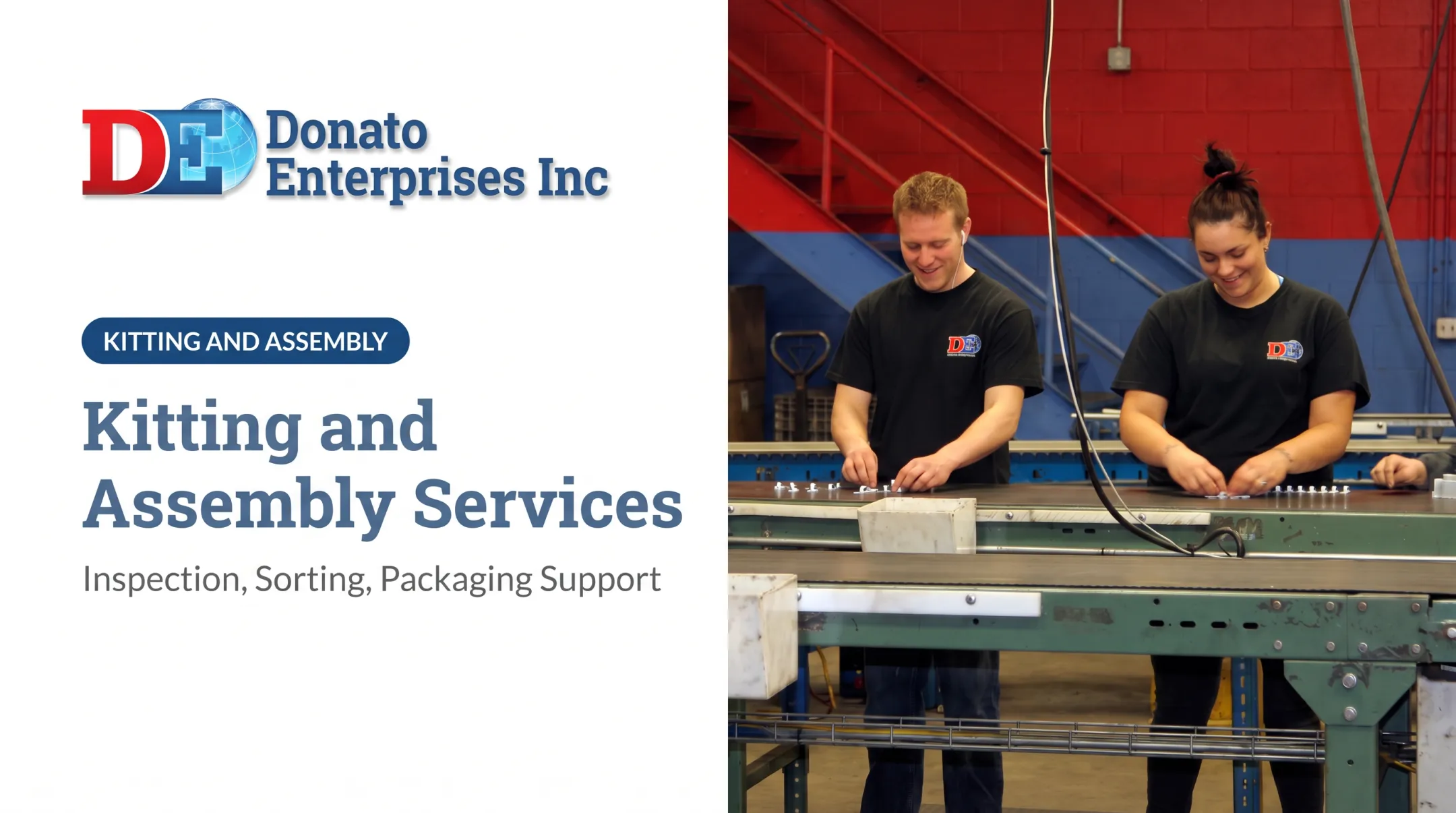
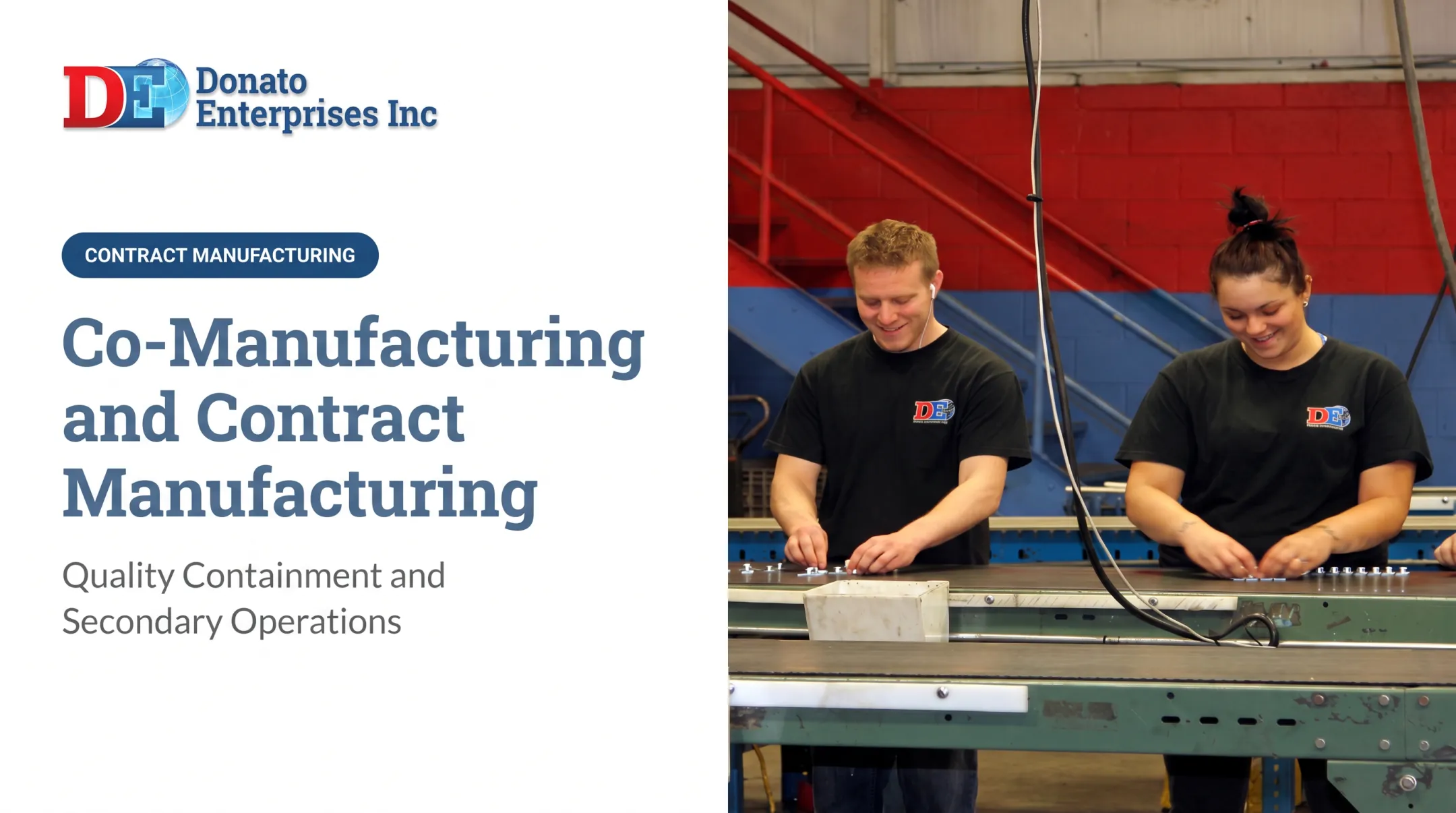
Donato Enterprises, Inc., a family-owned Michigan provider, is one example of that model. It combines assembly with inspection, sorting, packaging, cleaning, deburring, kitting, and containment support for manufacturers that need labor-heavy secondary operations off the main floor.
Its team reports over 100 years of combined experience and works from QS and ISO guidelines and GP12 processes.
Start with a Pilot
Run a sample or pilot first. Before you expand scope, lock in:
- Approval criteria and change-control procedures
- Confidentiality expectations
- Escalation contacts
- A process for handling nonconforming parts
Track KPIs and Act on Them
After launch, track these KPIs:
- Cost per unit and turnaround
- Defect escapes, rework, and first-pass yield
- On-time delivery and response time
- Capacity released on your floor

Hold regular reviews, and turn poor results into corrective actions and updated instructions.
Conclusion
Assembly outsourcing can improve control, capacity, quality, and consistency when the work is clearly defined and matched with the right provider. The gains compound when you measure total cost, quality, delivery, and throughput instead of judging on price alone.
Treat it as an ongoing strategy. Revisit it as volumes, customer requirements, and internal constraints change.
Frequently Asked Questions
What is manufacturing outsourcing?
It's using an external provider for selected production or support activities. Outsourcing only assembly-related tasks is narrower: you keep core production and hand off one defined secondary process.
What are assembly operations?
They include joining components, subassembly, inspection, sorting, rework, deburring, kitting, packaging, and labeling. The exact mix depends on the product and the provider.
What are the four types of outsourcing?
Classifications vary. A common framework lists professional, operational, manufacturing, and process-specific outsourcing, but it isn't a universal standard.
What are the benefits of outsourcing assembly?
Potential benefits include lower overhead, better quality control, flexible capacity, faster throughput, and more internal focus. Results depend on partner capability and process controls.
How do I choose an assembly outsourcing partner?
Check experience, quality systems, traceability, capacity, communication, pricing transparency, and responsiveness. Confirm they can support both the assembly and any secondary operations you need.
Is assembly outsourcing suitable for small or low-volume manufacturers?
It can be, when low volume doesn't justify dedicated labor, equipment, or floor space. Confirm minimum order requirements and total costs before committing.