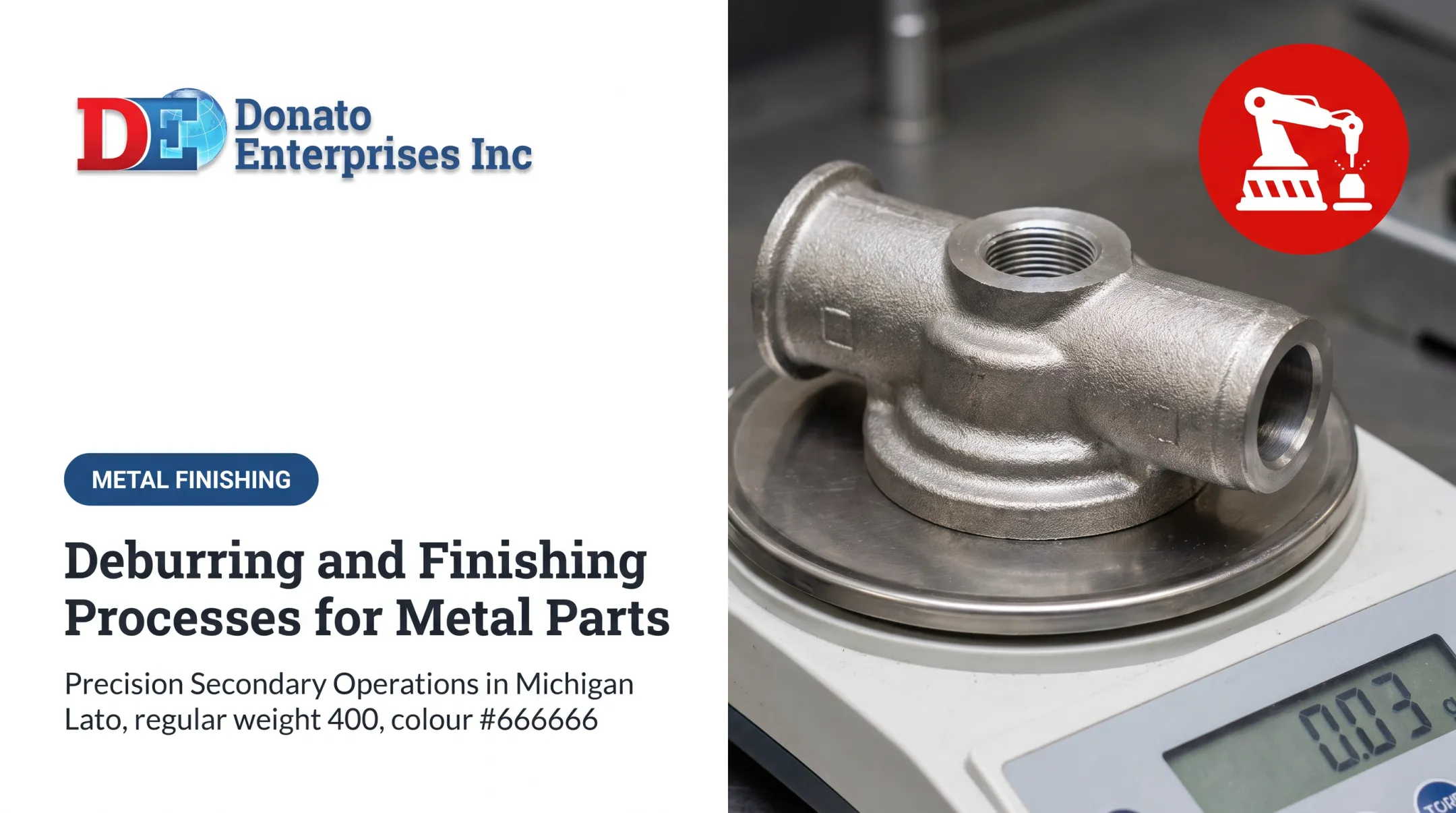
Tumble finishing is a mass-finishing process. Parts, media, and often water or compound move together in a controlled way to deburr, smooth, clean, burnish, or polish components in batches. SME's 2016 trade article reports sharp edges cutting workers during assembly and a tiny burr on an engine component causing assembly problems.
This guide covers the process steps, media selection, machine variables, applications, quality risks, and how tumbling differs from vibratory finishing.
Key Takeaways
- Tumbling improves edge condition, cleanliness, and appearance on many small and mid-sized metal parts.
- Media, loading, compound, water, speed, and time must match the required finish.
- No universal cycle time exists for stainless steel; trials and inspection set it.
- Reduces manual rework without replacing every grinding, coating, or inspection step.
What Is Tumble Finishing for Metal Parts?
What does tumble finishing mean in manufacturing?
In rotary barrel tumbling, parts and selected media ride together inside a rotating container. Kramer Industries describes friction between parts and media, and among the parts themselves, gradually changing the surface.
The goal shapes the recipe:
- Deburring: removing burrs
- Edge breaking: rounding sharp corners
- Smoothing and polishing: changing surface texture
- Burnishing: brightening through contact, without real metal removal
- Cleaning or prep: readying parts for coating or assembly
Don't assume one cycle delivers all of these. Tumbling also differs from chemical or electrochemical treatments and from coating or plating. Metal finishing is classified in different ways across the industry, so a fixed "three types" list is a rough guide rather than a universal standard.
How does tumble finishing differ from vibratory finishing?
"Mass finishing" is the umbrella. Rotary tumbling and vibratory finishing are separate choices under it.
| Factor | Rotary barrel | Vibratory |
|---|---|---|
| Motion | Load slides and tumbles in a rotating barrel | Vibration moves the whole load in a bowl or tub |
| Speed | Kramer describes it as slower | Kramer describes shorter cycles |
| Typical fit | Small to midsize batches needing fine smoothing, per Walther Trowal | Delicate or close-tolerance parts, per Kramer |
These are vendor descriptions. Actual contact depends on the machine, load, and workpiece. Noise levels vary by machine and load, so measure exposure in your own plant.
Which metal parts are commonly tumble finished?
Stampings, machine parts, forgings, castings, aluminum die castings, and small bearing components are frequent candidates. Brackets, fasteners, and fittings often fit as well, though each needs its own trial. Typical needs include burr reduction, cleanup after fabrication, cosmetic improvement, and prep for assembly or later surface treatment.
How the Tumble Finishing Process Works
Preparing parts and equipment
Inspect incoming parts first. Locate the burrs and sharp edges, and confirm the part can tolerate contact with media. Remove heavy oil or contamination when needed; some compounds also clean or degrease during the cycle, according to Walther Trowal.
Clean the barrel, liner, drain, and media before changing metals, compounds, or finish targets. Cross-contamination causes staining and embedded residue.
Selecting wet or dry processing
Wet tumbling uses water, usually with a compound. Water lubricates contact, carries away residue, and helps clean. Kramer says wet tumbling is used almost exclusively for excess stock removal, while dry processing works across phases, including polishing.
Wet processing brings wastewater handling and drying. Dry processing uses dry media or abrasive additives.
Loading parts, media, and compounds
Fill level, part fragility, and part-to-part contact all affect consistency. Kramer's guide suggests:
- 45% to 60% load height
- Roughly 3:1 media-to-parts, up to 6:1 for large or fragile parts
That's one vendor's guidance, not a universal ratio. Validate it on your parts.
Media should separate and cushion parts while still reaching edges, recesses, and holes.
Running and monitoring the cycle
Speed, intensity, duration, media condition, water level, and compound concentration all shape the result. Kramer lists horizontal barrel speeds of 20 to 38 rpm depending on barrel size and work. He warns that excess speed can worsen finish and cause pitting or impact damage.
Pull sample parts during development and production rather than trusting a fixed time. Staged processing often works best: an aggressive deburring stage, then smoothing, burnishing, or brightening.

Separating, cleaning, drying, and inspecting
After the cycle:
- Separate parts from media.
- Rinse with fresh water after wet runs.
- Dry the parts. Kramer mentions corn-cob media, heat lamps, or spinning.
- Clear media from holes, threads, slots, and recesses.
- Inspect for burrs, scratches, dents, discoloration, corrosion, residue, and dimensional change.
Check the handling, wastewater, chemical, and worker-safety rules for your facility before running production.
Choosing Media, Equipment, and Process Settings
Match media to the metal and finishing goal
| Media | Typical role | Caution |
|---|---|---|
| Ceramic | Stronger cutting; Walther lists it for steel, stainless, and nonferrous metals | Can be too aggressive for soft or cosmetic parts |
| Plastic/synthetic | Gentler contact for aluminum, die castings, delicate parts | Match abrasive content to the target finish |
| Steel shot or pins | Burnishing and brightening, not metal removal | Don't mix with abrasive media; may only dull light burrs |
| Dry organic (corn cob, walnut shell, wood) | Cushioning, drying, and carrying abrasives | Condition and added abrasive affect results |
Before committing, check compatibility, staining risk, media wear, and compound compatibility.
Select shape and size for the geometry
Larger media cut faster; smaller media give a finer finish, per Kramer. Wrong-sized media lodges in holes, threads, and slots.
Rösler lists triangles, cylinders, cones, ellipses, and pyramids, and none is universally best. Protect thin walls, threads, precision features, and cosmetic surfaces from heavy impact.
A 2020 barrel-finishing study found restricted media access slowed finishing on some angled internal surfaces. Validate internal passages directly.
Choose equipment for production needs
Rotary barrels, vibratory systems, and centrifugal high-energy machines each suit different jobs. Kramer says high-energy processing can be much faster than barrels, but offers no general benchmark. Weigh these factors against the job:
- Part fragility and finish target
- Batch size and throughput
- Floor space, noise, and process control Let the part and finish specification drive the choice, not the machine's advertised speed.
Control water, compounds, and contamination
Water and compound influence lubrication, cleaning, corrosion control, brightness, and load movement. Kramer notes that less water cuts faster while more water gives a finer, slower cut, and that inadequate water can cause scratches or black parts from embedded abrasive.

Keep the wet process under control:
- Track concentration and replenish on schedule
- Confirm compound compatibility with the media and metal
- Keep media clean and separate incompatible materials
Establish a repeatable process window
Document these for every part:
- Material, dimensions, geometry, and starting condition
- Media specification and load
- Water and compound settings
- Machine speed and cycle stages
- Acceptance criteria
Run pilot trials on representative parts. Compare results with measurable requirements such as burr condition, roughness, cleanliness, edge radius, or dimensional limits. Treat any published ratio or time as a starting point, not a guarantee.
Benefits, Applications, and Limitations
Benefits for manufacturers
Batch processing replaces repetitive hand deburring and handles many parts at once. Walther Trowal's white paper cites a jet-engine blisk finished in a few hours instead of days, though that example covers mass finishing generally rather than rotary barrels alone.
Practical gains:
- Safer edges
- Cleaner components
- More uniform appearance
- Less handling
- Better readiness for assembly or coating
Common industrial applications
Common candidates for tumbling include:
- Stamped parts and machined components
- Die-castings and foundry parts
- Fasteners, brackets, and fittings
- Automotive components
A stamping shop might run burr reduction before assembly. A caster might remove residue and condition edges before coating. The right process still depends on material and geometry.
Limitations and risks
Tumbling may not remove deep scratches, large amounts of stock, severe deformation, or difficult internal burrs without pre-processing or another method. In the 2020 study, one 12-hour test condition produced a 41% Ra reduction on complex parts, but that was a study result, not a production promise.

Watch for:
- Part-to-part dents
- Unwanted edge rounding
- Dimensional change
- Media lodging
- Discoloration and corrosion
- Inconsistent results from overloaded batches
Tight-tolerance and safety-critical parts need documented validation, not eyeballing.
Quality Control, Outsourcing, and Practical Takeaway
Quality checkpoints after tumble finishing
Inspect for:
- Burr removal and edge condition
- Surface finish
- Cleanliness
- Trapped media
- Corrosion and discoloration
- Dimensional compliance
- Batch-to-batch consistency
Agree on criteria before production, based on the customer drawing, function, downstream process, and cosmetic expectations. ISO 13715 gives rules for indicating undefined edges but no universal acceptable burr size, so set drawing-level limits yourself.
Troubleshooting inconsistent results
- Scratches or dents: media or part-to-part contact
- Insufficient deburring: unsuitable media or cycle conditions
- Trapped media: wrong media geometry
- Discoloration or residue: water, compound, or cleaning problems
Change one variable at a time, whether media, load, compound, speed, or duration, so you can tell what caused the change.

When outside manufacturing support may help
When internal capacity runs short or a customer issue demands fast containment, many manufacturers outsource labor-heavy inspection, sorting, cleaning, deburring, rework, assembly, and packaging.
Donato Enterprises, Inc., a family-owned provider in Memphis, Michigan, supports manufacturers with inspection, sorting, cleaning, deburring, assembly, packaging, and quality assurance. The team has more than 100 years of combined experience. The company does not offer tumble finishing or tumbling equipment. It complements a finishing line by handling inspection and sorting of finished parts, hand deburring of edges a barrel can't reach, and containment when a quality issue hits.
Practical takeaway
Successful tumble finishing means matching the system, media, compound, loading, and cycle to the part's material, geometry, tolerance, and finish.
Start with representative samples, document acceptance criteria, and validate before production. Bring in qualified support when inspection, containment, or secondary operations exceed in-house capacity.
Frequently Asked Questions
What are the three main types of metal finishing?
Classifications vary by source. A common shorthand splits them into mechanical finishing, chemical or electrochemical treatments, and coatings or plating. Treat it as a convenient grouping, not a universal standard.
What is the tumbling process?
Metal parts and selected media go into a rotating barrel or related system. Controlled contact deburrs, smooths, cleans, burnishes, or polishes the parts in batches.
How long to tumble stainless steel?
No single duration applies. Time depends on grade, geometry, burr condition, media, equipment, compound, load, and target finish. Run sample tests and inspect.
What media is used for tumble finishing metal parts?
Ceramic cuts aggressively, plastic is gentler, steel burnishes, and dry organics cushion and carry abrasives. Choose by material, geometry, aggressiveness, and desired finish.
Can tumble finishing remove burrs from metal parts?
It removes or reduces many accessible burrs and sharp edges. Large, deep, or internal burrs may need pre-processing or a specialized deburring method.
What is the difference between tumble finishing and vibratory finishing?
Rotary barrels slide and tumble the load; vibratory systems shake it. The better choice depends on part delicacy, geometry, throughput, finish goal, and tolerance.