This guide is for manufacturers, automotive suppliers, distributors, warehouse teams, and operations leaders. Kitting affects accuracy, production continuity, quality, labor use, and delivery performance.
People often describe kitting as "just putting parts in a box." Effective kitting takes planning, inventory controls, work instructions, quality checks, and clear ownership. Below, we cover the process step by step, where it is applied, what drives results, common problems, and when another workflow is a better choice.
Key Takeaways
- Kitting turns many component picks into one controlled kit while keeping each part visible.
- Reliable kits depend on an accurate BOM, correct inventory, standard work, and verification before release.
- Pre-kitting suits stable demand and available storage. Kitting to order suits variable demand and tight space.
- Kitting does not replace assembly controls when parts are fastened, modified, or function-tested.
What Is the Warehouse Kitting Process, and Why Is It Used?
What Is Warehouse Kitting?
Warehouse kitting gathers individual items into a defined unit for a specific production, fulfillment, maintenance, or shipping need. The ASCM Dictionary defines a kit as components of a parent item pulled from stock and prepared for movement to a production area.
The goal is simple. The person receiving the kit has the right parts, quantities, documentation, and packaging without hunting through multiple locations.
How kitting differs from related work:
- Assembly: joins or modifies parts into a functional product or intermediate unit. Kitting only prepares material.
- Pick-and-pack: picks items for an order. Component picking can feed a kit, but the two are not the same thing.
- Bundling: sells items together, often without component-level verification or a production purpose.
Why Do Manufacturers and Warehouses Use Kitting?
Kitting cuts repeated searching, travel, handoffs, and individual picks on recurring jobs like automotive production, replenishment, maintenance, and customer orders. NIST kitting research links the practice to less assembly space, less walking and searching, and more flexibility.
Industrial environments expect more from a kit:
- Repeatability and inventory accuracy
- Line-side availability
- Protection from damage
- Revision control
- Predictable delivery
Without control, kits fail in familiar ways:
- Missing hardware
- Mixed revisions
- Incomplete orders
- Wrong labels
- Rework and line stoppages
A peer-reviewed kit-quality study found that wrong, missing, damaged, and wrong-quantity components are the classic kit errors, and that parts placed in the wrong kit drive many of those failures.
Kitting is usually an operational best practice, a customer-specific requirement, or part of a quality system. It is not a universal regulatory mandate. PPAP, for instance, governs part approval and does not prescribe kitting.
How the Warehouse Kitting Process Works
The end-to-end flow: define the kit, confirm approved components, pick and stage them, group and package, verify, update inventory, and release. Most operations follow a sequence like this, though it is not a universal standard.

Step 1: Define the Kit and Its Requirements
Before work starts, settle these items:
- Kit identifier and component list
- Required quantities and revision level
- Packaging method and labels
- Substitution policy
- Documentation and destination
Step 2: Source, Pick, and Stage Components
Workers or warehouse systems locate parts, confirm part numbers and quantities, and check lot or serial requirements where they apply. Stage everything in a designated kitting area. Never let two kits share a staging space.
Step 3: Assemble and Package the Kit
Basic kitting may be grouping and packaging only. More involved work adds labeling, document inserts, protective materials, or limited assembly. Once parts are fastened or modified, you need separate work instructions.
Step 4: Inspect, Verify, and Record
This is the quality checkpoint. Confirm:
- Component identity and count
- Condition and revision level
- Label accuracy and packaging integrity
- Customer-specific requirements One study found that visible empty and filled slots made missing-component and wrong-quantity errors practically impossible in one case.
Match the method to the operation:
- Barcode scanning
- Checklist signoff
- Weight checks
- Photographs
- Dual verification
Don't assume a system does this for you. In SAP EWM, for example, a kit completeness check at goods issue depends on configuration.
Step 5: Stage, Release, and Update Inventory
Assign each completed kit a storage or delivery location. Move it to production or outbound staging. Record the move so kit status and remaining component inventory both stay accurate.
Where Warehouse Kitting Is Applied and What Affects Results
Where Is Warehouse Kitting Applied?
Manufacturing and line-side delivery. Automotive suppliers are the clearest case. Studies compare kitting with continuous supply in automotive assembly, weighing man-hours, quality, flexibility, inventory, and space. Stamping, injection molding, die casting, and foundry operations use the same approach, grouping parts before production or secondary operations.
Customer-facing uses. Replacement-part sets, maintenance kits, promotional packages, and replenishment packs all rely on kitting.
Common triggers:
- Repeated bills of materials
- New production launches
- Safe-launch or containment periods
- Orders needing multiple components
- Limited production-floor space
- Labor-heavy preparation that needs outsourcing
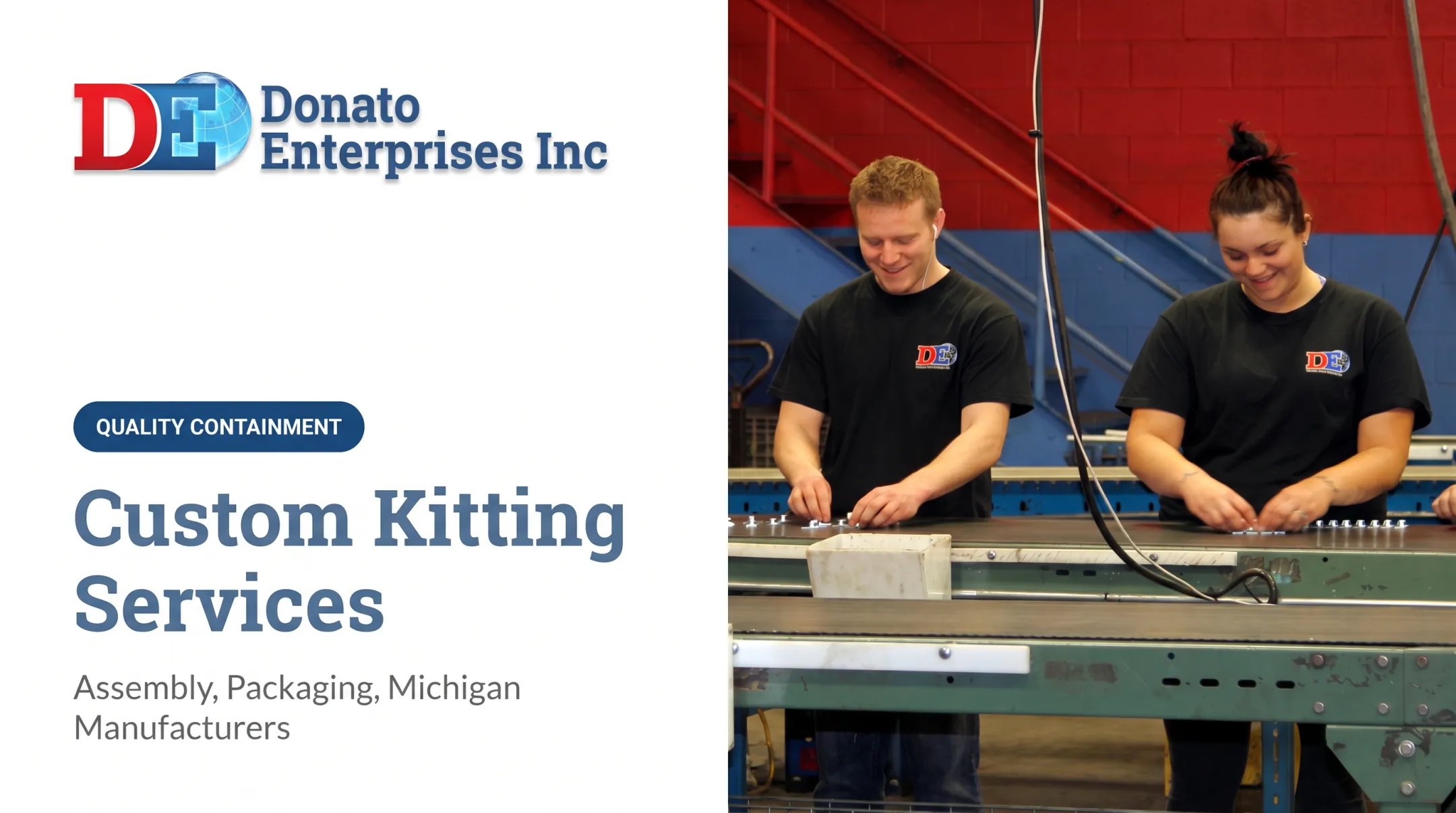
Donato Enterprises supports manufacturing clients with kitting, assembly, packaging, inspection, sorting, and quality assurance. Companies turn to outside help when that work is labor-heavy or quality-sensitive. Donato assembles customer-supplied parts into kits to specification for both large and small orders.
Key Factors That Affect Warehouse Kitting Results
Use this checklist to audit your operation:
- Inputs and materials: part identity, quantity, condition, packaging requirements, lot or serial controls, revision level, and approved-component availability.
- Operating conditions: workstation layout, lighting, cleanliness, moisture or temperature sensitivity, deadlines, and clear work instructions.
- Equipment and systems: shelving, carts, scales, scanners, label printers, warehouse software, barcode rules, and inventory transactions.
- Scale and frequency: recurring demand, kit complexity, variations, batch size, labor, storage, and the pre-kit versus kit-to-order choice.
- Safety, quality, and regulatory constraints: ergonomic handling, load limits, segregation of nonconforming material, traceability, and documented approval for substitutions.

On ergonomics, OSHA's warehousing guidance lists lifting, bending, overhead reaching, and repetitive tasks as risk factors. Design kit stations around them.
Pre-Kitting vs. Kitting to Order
| Approach | Best when | Trade-off |
|---|---|---|
| Pre-kitting (kit-to-stock) | Demand is stable and repeatable | Adds kit inventory and storage |
| Kitting to order | Demand or composition varies, space is tight | Prep happens after the request |

No published numeric threshold separates the two. Compare demand variability, component size and weight, storage space, and the cost of extra upstream handling.
Common Issues, Misconceptions, and Limitations
Common Issues and Misconceptions
A full container is not an accurate kit. Part number, quantity, revision, condition, and label checks still matter. Under PPAP-driven packaging, for instance, each new package is verified for correct quantity and label accuracy.
Orderly-looking kits can still be wrong. Common causes:
- Unclear ownership
- Inconsistent work instructions
- Shared staging areas
- Poor inventory transactions
- Last-minute substitutions
A kit is not the finished result. Kitting improves readiness and reduces handling. It does not guarantee product quality when assembly, inspection, or functional testing is required.
When the Warehouse Kitting Process May Not Be Appropriate
Kitting can be inefficient with:
- Highly unpredictable demand
- Frequently changing component combinations
- Low-volume one-off orders
- Insufficient storage space
- Components that must stay individually available
Other workflows may fit better:
- Direct picking or line stocking when extra preparation outweighs the fetching saved
- Sub-assembly when work requires fastening, modification, or testing
- Cross-docking to move goods from receipt to issue without putaway (without grouping or verifying components as a kit)

Signs kitting is used by default rather than need:
- Excess finished-kit inventory
- Frequent kit breakups
- Obsolete components
- Repeated rework
- Extra handling with no measurable gain in flow or accuracy
Conclusion
Warehouse kitting converts separate, verified components into a controlled unit that is easier to move, use, fulfill, or deliver. Strong results come from accurate kit definitions, disciplined picking and staging, documented work, quality verification, inventory visibility, and a deliberate choice between pre-kitting and kitting to order.
Apply it where it fits. Match kitting to demand, kit complexity, storage capacity, and quality requirements, and recognize when the job is really assembly.
Frequently Asked Questions
What is the warehouse kitting process?
It is the controlled grouping of components into one kit. The main steps are defining the kit, picking and staging parts, packaging, verifying, updating inventory, and releasing the kit.
What is the difference between kitting and assembly?
Kitting groups existing components without joining them. Assembly fastens or modifies components to create a functional product or sub-assembly.
When should a warehouse pre-kit instead of kitting to order?
Pre-kit when demand is stable and repeatable and you have storage space. Kit to order when demand varies or space is limited.
What is kitting in SAP EWM?
SAP EWM supports kit-to-order and kit-to-stock within configured warehouse and inventory workflows. Exact functions, such as completeness checks, depend on release and implementation.
What is a kitting specialist?
A kitting specialist gathers, verifies, packs, labels, and records kit components per documented procedures. Employer postings, such as Baxter's kitting associate role, also include checking completeness against a BOM.
How does kitting improve warehouse accuracy?
Defined component lists, dedicated staging, scanning, standard work, and final checks reduce missing, wrong, or mixed components. No credible study isolates a kitting-specific accuracy gain from scanning, so measure results in your own operation.