Introduction
A single vehicle contains thousands of parts. Getting them onto the right car, in the right order, torqued to spec and inspected, takes a tightly controlled production flow. That flow is the automotive assembly line.
It is also where small problems turn expensive. One missed fastener or a burr on a stamped bracket can ripple through every downstream station. Suppliers feel it most when a customer flags a suspect part.
This article covers what an assembly line is, how the process works, the main line types, the role of automation and inspection, and when suppliers bring in external assembly support.
Key Takeaways
- Assembly lines split production into sequenced workstations with defined tasks.
- Modern lines mix people, robots, conveyors, sensors, and software.
- Line design balances throughput against safety, quality, flexibility, and traceability.
- External partners can handle overflow assembly, sorting, rework, kitting, and containment.
What Is an Automotive Assembly Line?
An automotive assembly line is a linked sequence of workstations where components and subassemblies are installed, joined, inspected, and tested on the way to a finished vehicle or component.
Static Versus Line-Based Assembly
In a fixed-position layout, the product stays put while workers and equipment come to it. In a product (assembly-line) layout, the product moves between stations, as OpenStax explains in its facility-layout chapter.
A Short History
Henry Ford did not invent the automobile, and Ford's own history says so. Earlier, Ransom E. Olds built Curved Dash cars on a stationary assembly line in 1901. Ford's contribution was the moving line at Highland Park in 1913.
The Library of Congress dates it to October 1913 and reports Model T assembly time falling from 12.5 hours to 93 minutes. Ford's own account says 90 minutes.
Why the Approach Stuck
- Standardized work made each task repeatable.
- Task specialization shortened training and sped up each step.
- Material presentation put parts within reach of the operator.
- Line balancing spread work evenly so no station held up the rest.
How Does an Automotive Assembly Line Work?
The exact sequence varies by vehicle, plant, and powertrain. Toyota Auto Body documents one example: pressing, welding, painting, assembly, detailed quality inspection, then shipment. EV plants add battery integration, and some plants place powertrain work in separate areas.

Body Shop and Material Flow
Body shops join structures with welding, fastening, and adhesive bonding, using fixtures to hold geometry and dimensional checks to confirm it. Robots and people both do this work.
Parts reach stations several ways:
- Line-side storage and carts
- Conveyors
- Automated guided vehicles and autonomous mobile robots
- Sequenced kits, arranged in order of use
ABB describes one engine plant running 60 AMRs for line supply, kitting, and shipping. That is one installation, not a benchmark.
Pace, Balance, and Bottlenecks
- Takt time: available production time divided by customer demand.
- Cycle time: time to complete one cycle of an operation.
- Line balancing: distributing work so no station is overloaded or idle.
If one station runs slower than takt, work piles up in front of it and everything downstream starves. Fixing the slowest station usually beats speeding up the fastest.
Traceability and Controls
Torque tools, sensors, and electronic work instructions record what happened at each station. A manufacturing execution system can tie that data to parts and processes. One Siemens automotive case describes traceability from raw material to finished product. Automotive quality standards expect lot or batch identification, though they do not mandate barcodes or RFID specifically.

Mixed-Model and EV Production
Mixed-model lines build gas and battery variants together. ASSEMBLY Magazine notes this adds line-balancing, materials, and staffing complexity. EV work also brings flexible tooling and high-voltage safeguards. OSHA flags stored electrical energy and thermal runaway as lithium-ion battery hazards.
Types and Technologies Used in Automotive Assembly Lines
Line Types
Plants do not follow one universal four-type standard. A practical grouping covers:
- Fixed-position: the product stays; labor and tools come to it.
- Straight moving line: stations in sequence along one flow.
- U-shaped line: stations curve so workers can cover adjacent steps.
- Parallel workstations: several stations do the same work to raise capacity.
Fixed-position is a facility layout, while the other three are line layouts. Many plants blend them.
Conveyor Options
| Conveyor | How it moves product | Typical fit |
|---|---|---|
| Chain (overhead, power-and-free) | Chain pulls carriers; power-and-free lets them stop independently | Assembly and inspection where buffering helps |
| Floor towline | Chain in the floor tows carts | Flexible floor routing |
| Skillet/skid | Product rides on a platform | Heavy or large assemblies |
Daifuku lists these for automotive use. Limits include fixed footprints and changeover effort. Ford's original line used a conveyor belt, but that alone does not make belts a current standard.
Manual, Automated, and Hybrid
KUKA describes manual, semi-automatic, and fully automatic automotive assembly systems. Most plants run hybrids. Robots handle welding, dispensing, and heavy lifting, while people handle tasks needing judgment, such as routing wire harnesses or catching a cosmetic flaw.
Automation and Data
Robots, cobots, machine vision, PLCs, force sensors, and torque-controlled tools coordinate the work and expose process drift. The IFR reports U.S. automotive robot installations rose 10.7% to 13,700 units in 2024.

Digital twins and predictive maintenance help validate layouts and plan for changeovers. Treat vendor claims on assembly-specific adoption and ROI carefully; published figures remain limited.
Quality, Safety, and Efficiency on the Assembly Line
Building Quality Into Stations
Good lines catch errors where they happen:
- Mistake-proofing (poka-yoke) and correct-part verification
- Torque and force monitoring
- Controlled work instructions
- Dimensional and functional checks
- Documented reaction plans
Automotive suppliers work under IATF 16949 plus customer-specific requirements, and use AIAG core tools: APQP, Control Plan, PPAP, FMEA, MSA, and SPC.
Inspection and Containment
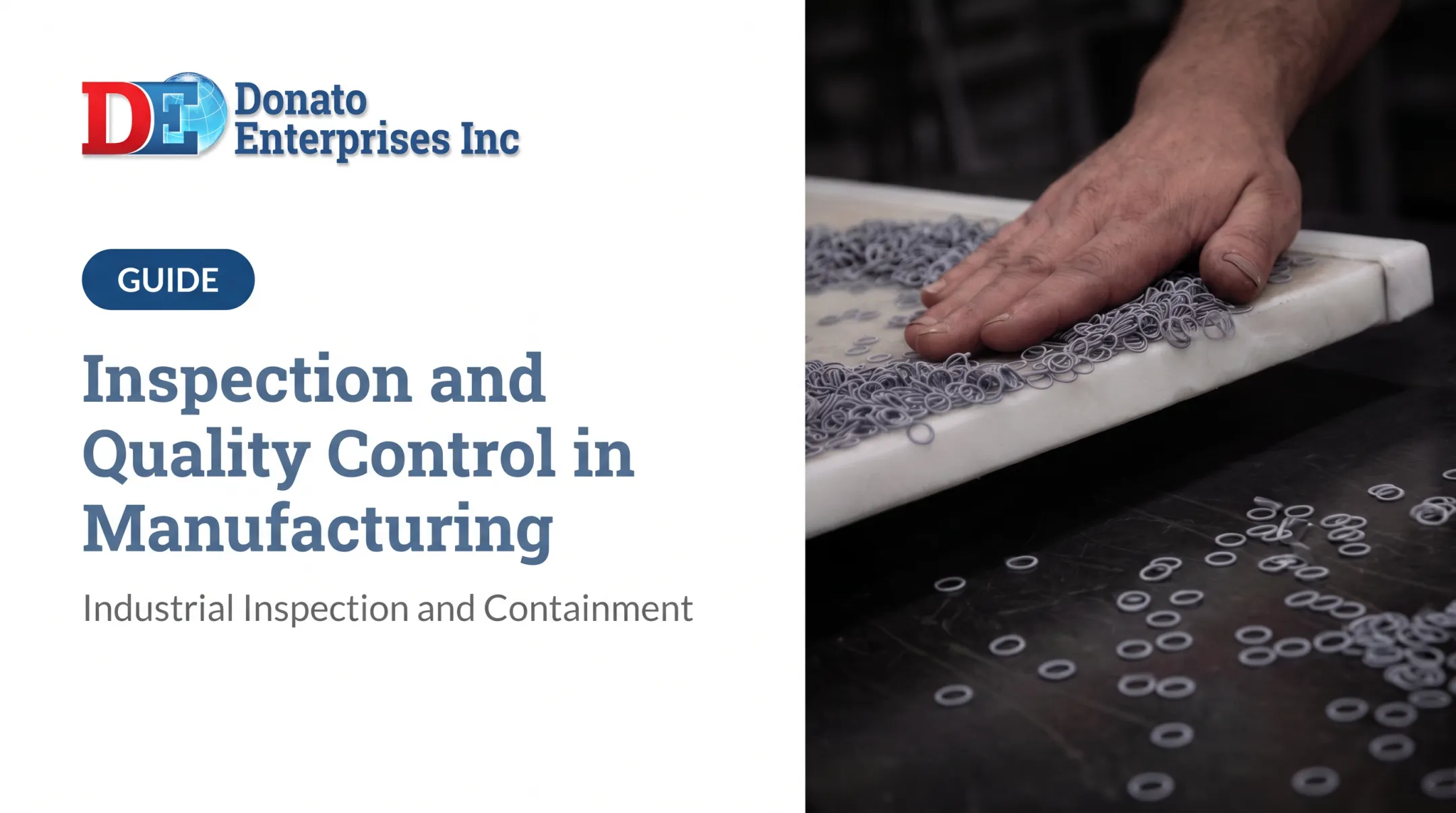
In-process checks find defects near their source, which limits rework and keeps suspect parts from moving on. End-of-line and audit inspections catch what slips through. Containment goes further: quarantine, sorting, and root-cause analysis.

Launch is a risk window. Allison Transmission's 2022 supplier manual describes GP-12 as a pre-launch control plan with added inspection, and CS1/CS2 as enhanced containment when normal controls fall short.
GM's October 2025 requirements replaced GP-12 with Early Production Containment. Terms are customer-specific, so check your customer's manual.
Common Defect Risks
- Wrong or missing components and fasteners
- Improper torque
- Weld or adhesive variation
- Burrs, flash, and cosmetic damage
- Dimensional drift and incomplete subassemblies
Safety and Ergonomics
- Machine guarding under 29 CFR 1910.212
- Lockout/tagout under 29 CFR 1910.147, which covers servicing and maintenance
- Robot safety: OSHA has no robotics-specific standard and points to ANSI/RIA R15.06
- Ergonomics: a 2019 NIOSH evaluation at an automaker examined push-pull forces and musculoskeletal symptoms
Measuring Performance
ASQ defines first-pass yield as (units entering minus defective units) divided by units entering. OEE multiplies availability, performance efficiency, and first-pass yield.
Also track:
- Scrap and rework
- Downtime and changeover time
- Throughput
- Customer complaints
Set targets from your own baseline and customer requirements, not generic industry numbers.
When Manufacturers Use External Assembly and Quality Support
Common Triggers
Tier 1 and Tier 2 suppliers bring in outside help when:
- A quality spill, suspect-part alert, or customer complaint hits
- A safe-launch window requires added inspection
- Labor-heavy work would tie up a main line or molding floor
- Floor space or headcount can't support sub-assembly, kitting, or repackaging
Those headcount limits sit against a wider labor squeeze. Deloitte and The Manufacturing Institute estimate as many as 3.8 million U.S. manufacturing jobs may be needed through 2033, though that figure is not automotive-specific.
What Support Looks Like
- 100% inspection and sorting
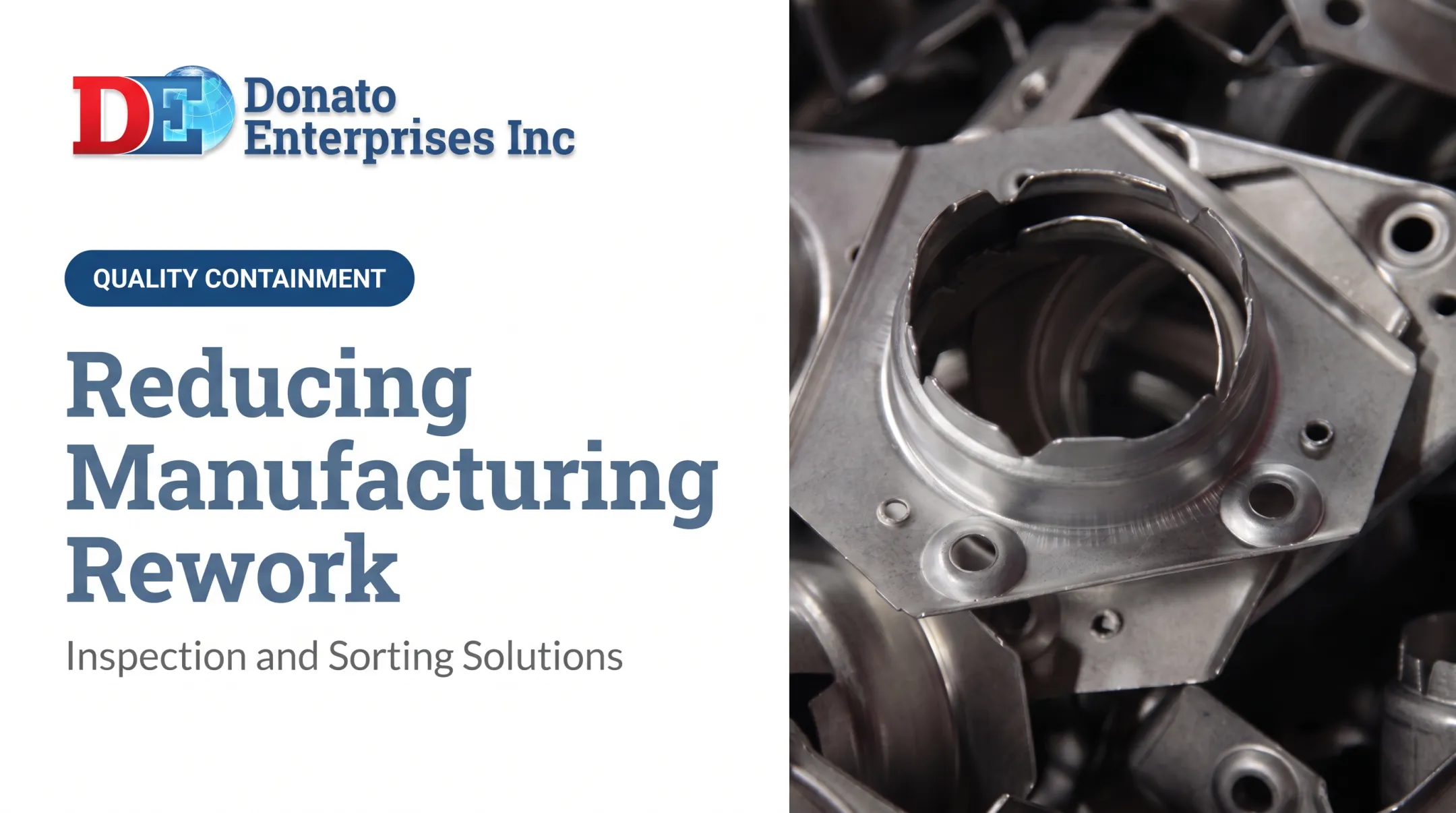
- Rework, deburring, and flash removal
- Parts cleaning
- Subassembly and kitting
- Packaging and repackaging
These services protect shipments while the root cause gets fixed.
Example: Donato Enterprises
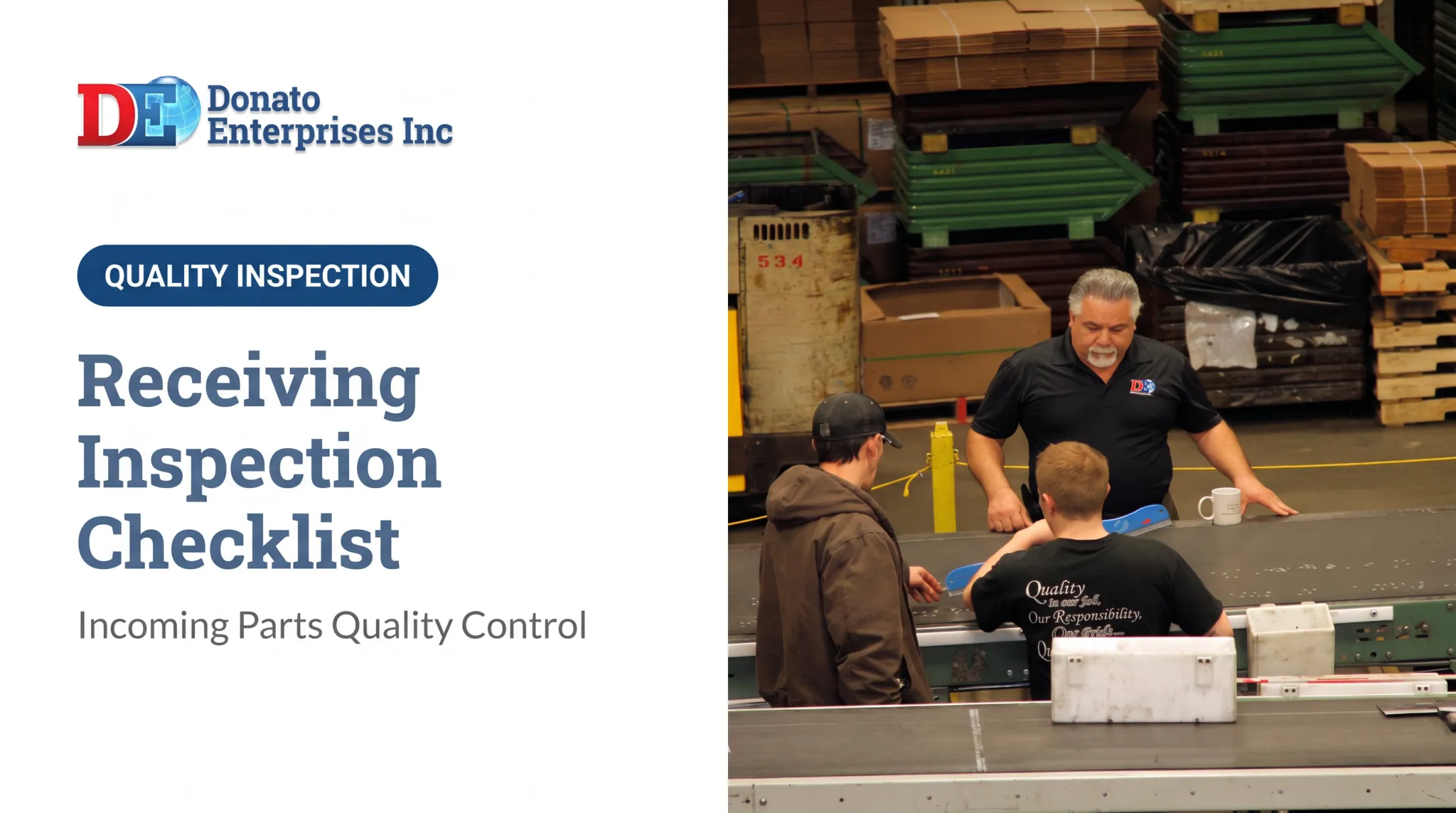
Donato Enterprises, Inc. is a family-owned provider in Memphis, Michigan, founded in 1996. It handles inspection, sorting, assembly, packaging, cleaning, deburring, kitting, rework, and quality containment on customer-supplied parts for automotive and other manufacturers.
Founder Chris Columbus Donato developed its proprietary inspection and containment processes. Its services include PPAP, GP-12, and safe-launch inspections on-site or at its facility. The company reports 99.965% sorting effectiveness against an 87% industry standard; ask for the measurement context before comparing it to your own data.

It supports parts makers. It does not design or automate complete OEM assembly lines.
Checklist for Evaluating a Partner
- Response time for urgent containment
- Inspection and assembly procedures
- Staffing capacity
- Traceability of lots and serials
- Reporting format and frequency
- Rework authorization process
- Packaging controls
- Escalation procedures
- Fit with customer-specific requirements
Several of these, such as response time and escalation, are worth getting in writing before you need them.
Frequently Asked Questions
What is an automotive assembly line?
A linked series of workstations where parts are installed, joined, inspected, and tested. Sequenced tasks, material flow, standardized work, and quality checks combine to build vehicles or components.
What are the four main types of assembly lines?
Common layouts include fixed-position, straight moving, U-shaped, and parallel-station lines. Many automotive plants use hybrids of these.
Who had the first automotive assembly line?
Ransom E. Olds used a stationary assembly line in 1901. Henry Ford introduced the moving assembly line at Highland Park in 1913, per the Library of Congress.
What is the assembly process in manufacturing?
Components pass through sequenced operations such as preparation, joining, installation, inspection, testing, and packaging or shipment.
How does quality control work on an automotive assembly line?
Stations use in-process checks, mistake-proofing, and traceability, followed by end-of-line testing. Defects trigger containment and corrective action.
What is the difference between automated and manual assembly lines?
Manual lines rely on people and hand tools. Automated lines use programmed equipment and controls. Hybrid lines combine both.