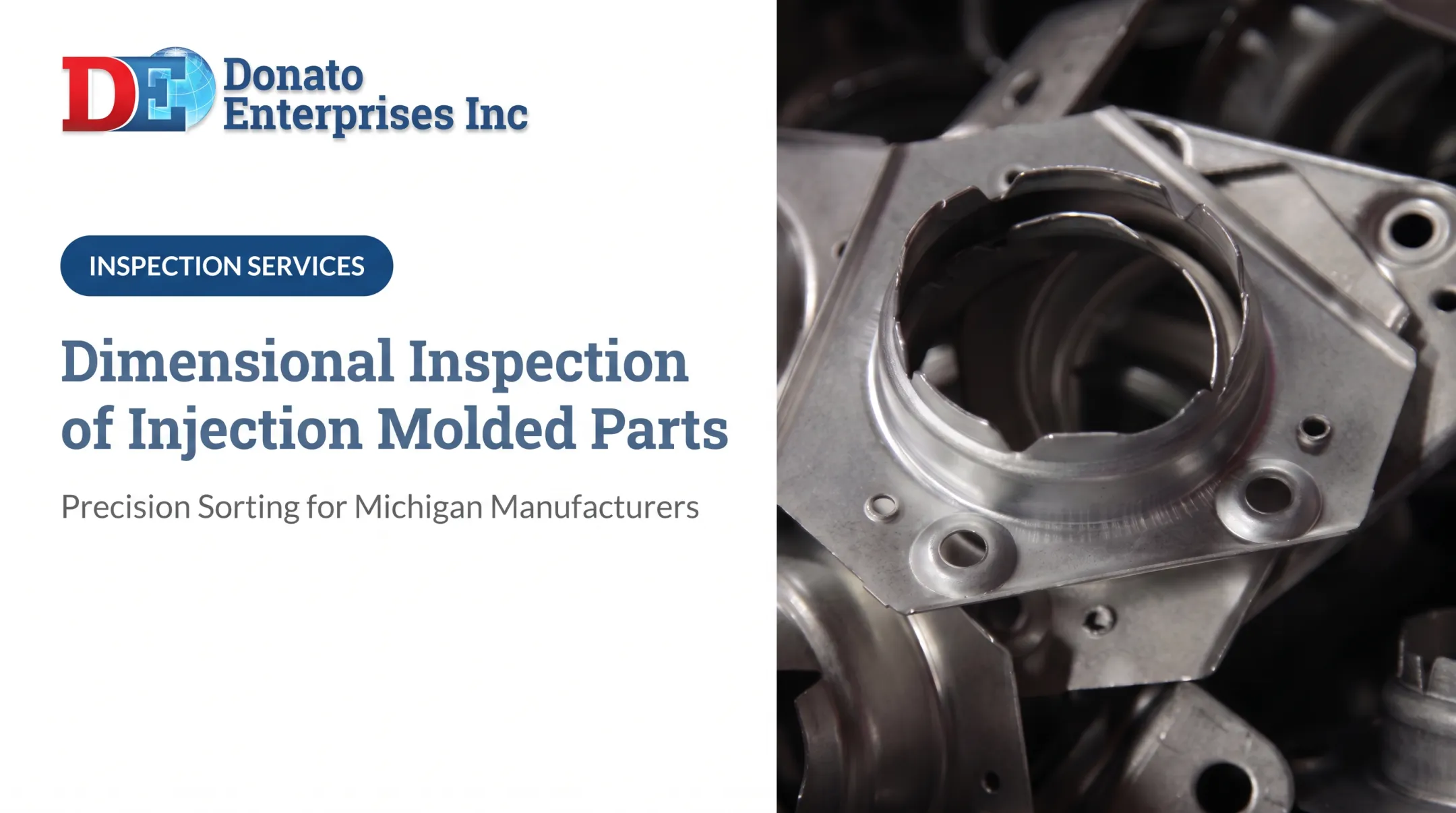
Now picture what that does downstream. Inconsistent shrinkage, flash, or warpage keeps a connector from seating, a seal from holding, or a clip from snapping into place.
Precision molding is a controlled approach to making tight-tolerance parts repeatably. This guide covers tooling, resin choice, process control, inspection, and the downstream quality support that protects parts after they leave the press.
Key Takeaways
- Define precision by the part's functional needs and repeatability, not a universal tolerance.
- Mold design, machine stability, resin, cooling, and measurement all work as one system.
- Precision pays off where fit, complex features, or high-volume consistency drive performance.
- Inspection, sorting, and containment protect quality after molding.
What Is Precision Plastic Injection Molding?
What Precision Means in Injection Molding
Precision injection molding produces plastic components with tightly controlled dimensions, repeatable features, and consistent performance across production cycles. No authoritative number separates "conventional" from "precision" molding, so the drawing and the application set the bar.
Several related requirements get lumped together but are separate:
- Dimensional tolerance: geometric and size limits on the part. ISO 20457 covers these for molded parts, and it does not address sink marks or flow structures.
- Measurement repeatability: how consistently a gauge or method reads the same feature.
- Part-to-part consistency: process capability across cycles.
- Surface finish: SPI A-1, for example, describes mold roughness (Ra 0.012-0.025 µm), not a tolerance.
- Cosmetic quality: appearance acceptance criteria.
What is achievable depends on part size, geometry, resin, tooling, machine capability, environment, and how you measure.
Precision Molding vs. Conventional Injection Molding
| Factor | Conventional | Precision |
|---|---|---|
| Mold accuracy | Standard tooling | Tighter cavity/core accuracy, rigid mold base |
| Process window | Broader | Narrow, documented, closely monitored |
| Material data | General datasheet use | Grade-specific shrinkage and conditioning |
| Inspection | Sampling, visual | Capability studies, gauge studies |
| Development effort | Lower | Higher (DFM, trials, validation) |
| Cost structure | Lower upfront | Higher tooling and validation, lower scrap risk |
Conventional molding suits parts with broader dimensional needs. Precision adds control where variation could affect fit, function, safety, or assembly.
Where Precision Molding Creates Value
- Automotive: a Bosch steering-angle sensor made with BASF Ultradur PBT.
- Medical: a PEEK micro-spring for a catheter tip, with a wall of about 40 µm.
- Electronics and optics: an MT ferrule that positions 0.125 mm fiber cores.
- Industrial: gears, clips, and sealed interfaces with mating features.
Specify tight control only where it contributes to performance. Holding every feature to the tightest tolerance adds cost without improving the product.
How the Precision Injection Molding Process Works
Tooling and Mold Design
Final dimensions start in the tool. Cavity and core accuracy, mold-base rigidity, parting-line control, venting, gate placement, ejection, and cooling-channel layout all shape the part.
Tool steel matters over long runs. Uddeholm's 2021 guide ties steel selection to resin, run length, shot count, mold size, and surface finish. Wear resistance, toughness, and thermal conductivity all count, and no single hardness fits every tool. Maintenance keeps the mold consistent over time.
Machine and Process Control
Variables to control:
- Resin and mold temperature
- Injection speed and pressure
- Hold pressure and screw position
- Cooling time and cycle consistency
Closed-loop systems reduce shot-to-shot drift. ENGEL's iQ weight control, for example, compares each cycle's injection pressure and screw position with a reference cycle, then adjusts speed profile, changeover point, and hold pressure. That is one OEM's system, not a universal result.
Injection Molding Approaches Used for Precision Parts
- Conventional single-shot: simplest tooling, one material.
- Insert molding and overmolding: plastic formed around inserts or substrates; material compatibility and insert positioning drive validation.
- Two-shot or multi-material: multiple components in one process, with more complex tooling. ARBURG describes systems for up to six components.
- Micro-molding: very small parts, some under 1 g, using small-shot equipment.
More complexity means more tooling work, tighter material compatibility checks, and heavier validation.
Material Flow, Cooling, Shrinkage, and Warpage
Flow direction, wall-thickness changes, fiber orientation, uneven cooling, moisture, and mold-temperature differences all create shrinkage or warpage. Covestro separates the two: shrinkage is volume change, warpage is shape change.
Glass fibers orient mainly along the flow direction, so uneven orientation warps parts. BASF recommends gate and flow planning for more uniform orientation.
Gate example: In an Autodesk Moldflow case, a glass-filled PP automotive bracket with two gates warped nearly 6.0 mm. A single-gate revision forecast 1.3 mm; sampled parts measured 1.1 mm and met spec. That is one case, not a general benchmark.

Validation, Measurement, and Production Monitoring
A practical sequence:
- DFM review
- Mold trials
- First-article inspection
- Dimensional studies and capability analysis
- Process approval
- Ongoing production checks

Match gauges, vision, CMM, sampling, and traceability to the part's risk and tolerance. Frameworks differ by industry.
AIAG's core tools (APQP, Control Plan, PPAP, FMEA, SPC, MSA) apply to automotive. Ford, for instance, lists Ppk of at least 1.67 for initial capability and Gage R&R under 10% of tolerance as acceptable, but those are customer-specific.
For medical, FDA's QMSR incorporates ISO 13485:2016, and its applicability to a component molder depends on role and context.
Materials and Design Decisions That Affect Precision
Choosing the Right Resin
There is no single best plastic. The right resin depends on strength, stiffness, impact, heat, chemical contact, electrical performance, wear, appearance, regulations, and service life.
Candidate families include commodity thermoplastics, engineering resins, reinforced compounds, and high-performance polymers such as PEEK. Compare current manufacturer datasheets, since values are grade- and test-condition-specific:
| Grade | Reported shrinkage |
|---|---|
| BASF Ultramid B3EG6 (PA6-GF30) | 0.25% parallel, 0.70% normal to flow |
| Covestro Makrolon 2405 (PC) | 0.70% normal |
| Covestro Bayblend FR3042 (PC/ABS) | 0.50-0.70% both directions |

Don't infer family averages. ISO 294-4 molding shrinkage also excludes moisture uptake, which matters for nylon: the PA6-GF30 grade above absorbs 1.9-2.3% water at equilibrium (23 °C, 50% RH).
Fillers, Reinforcement, and Material Stability
Glass fiber, mineral, and carbon fillers change stiffness, shrinkage, flow, surface appearance, and anisotropy. Reinforced grades often shrink differently along and across flow.
Handling matters just as much:
- Dry moisture-sensitive resins correctly. Toray's PBT guide calls for 3-5 hours at 120-130 °C, with pellets at or below 0.02% water.
- Use hopper drying to limit re-absorption.
- Keep blending consistent and track lot traceability.
Design for Precision and Manufacturability
- Keep wall thickness uniform; Envalior calls nominal wall the first manufacturability decision.
- Add draft on surfaces parallel to mold draw.
- Use radii, ribs, and bosses deliberately, and plan snap-fits, gates, vents, ejectors, and datums early.
Identify critical-to-function features up front rather than tightening the whole part. Then run a DFM review covering resin behavior, filling, cooling, tooling access, measurement strategy, and volume.
AI-Assisted Mold Design
AI and simulation tools can help analyze geometry, flag fill or warpage risks, suggest iterations, and organize past process data. Treat AI process models and CAE simulation as separate tools. A peer-reviewed Springer study on neural-network transfer learning covers process modeling, and CAE simulation remains the standard for fill and gate analysis.
AI doesn't replace mold designers, material suppliers, process engineers, or quality staff. Validate every recommendation against real tooling, resin, machine, and inspection results.
Applications and When Precision Molding Makes Sense
Sensor components, connector bodies, clips, housings, and seals all depend on dimensional consistency for fit and customer acceptance.
Tier 1 and Tier 2 suppliers feel this most during launch programs, high-volume runs, and when parts draw customer complaints or suspect-part alerts.
Precision molding also shows up in other sectors:
- Electronics: miniaturization and insulation
- Medical: micro features and cleanliness
- Industrial: repeatable interfaces and wear
- Optical: fiber alignment and tight positional control
- Consumer: complex features and sealing
Deciding whether precision is worthwhile
Weigh these factors:
- Functional tolerances and defect consequences
- Annual volume and tooling investment
- Assembly requirements and material behavior
- Inspection needs
- Cost of scrap and rework
Conventional molding, secondary machining, or a hybrid may beat holding every molded feature to an extreme tolerance. No universal break-even exists, so run the numbers for your part.
Quality Control and Common Defects
Quality Checks Across the Production Lifecycle
A solid control plan typically covers incoming resin verification, mold setup, first-piece approval, in-process monitoring, dimensional and visual inspection, part-weight checks where relevant, final release, and record retention. Traceability, nonconformance procedures, and corrective actions keep results repeatable across shifts, lots, and runs.
A Kistler case shows the payoff: cavity-pressure monitoring exposed a gate and fiber-flow problem, and scrap fell from 13% to 8% after process optimization.

Common Defects and Their Root Causes
BASF's troubleshooting guide supports these cause-and-action pairs:
| Defect | Likely cause | Typical response |
|---|---|---|
| Flash | Low clamp force, damaged sealing surface, excess cavity pressure | Correct clamp/fit, change over earlier, reduce speed |
| Short shot | Cold melt or mold, poor venting, long thin flow | Raise temperature, improve vents, revise gate or wall |
| Sink mark | Thick section, insufficient packing | Increase hold pressure |
| Weld line | Melt fronts meeting | Analyze fill |
| Burn | Trapped air | Check venting, reduce clamp force |
| Void | Heavy shrinkage, low packing | Raise hold pressure/time |
| Warpage | Short cooling, fiber orientation | Lengthen cooling, plan gates |

Containment and Secondary Quality Support
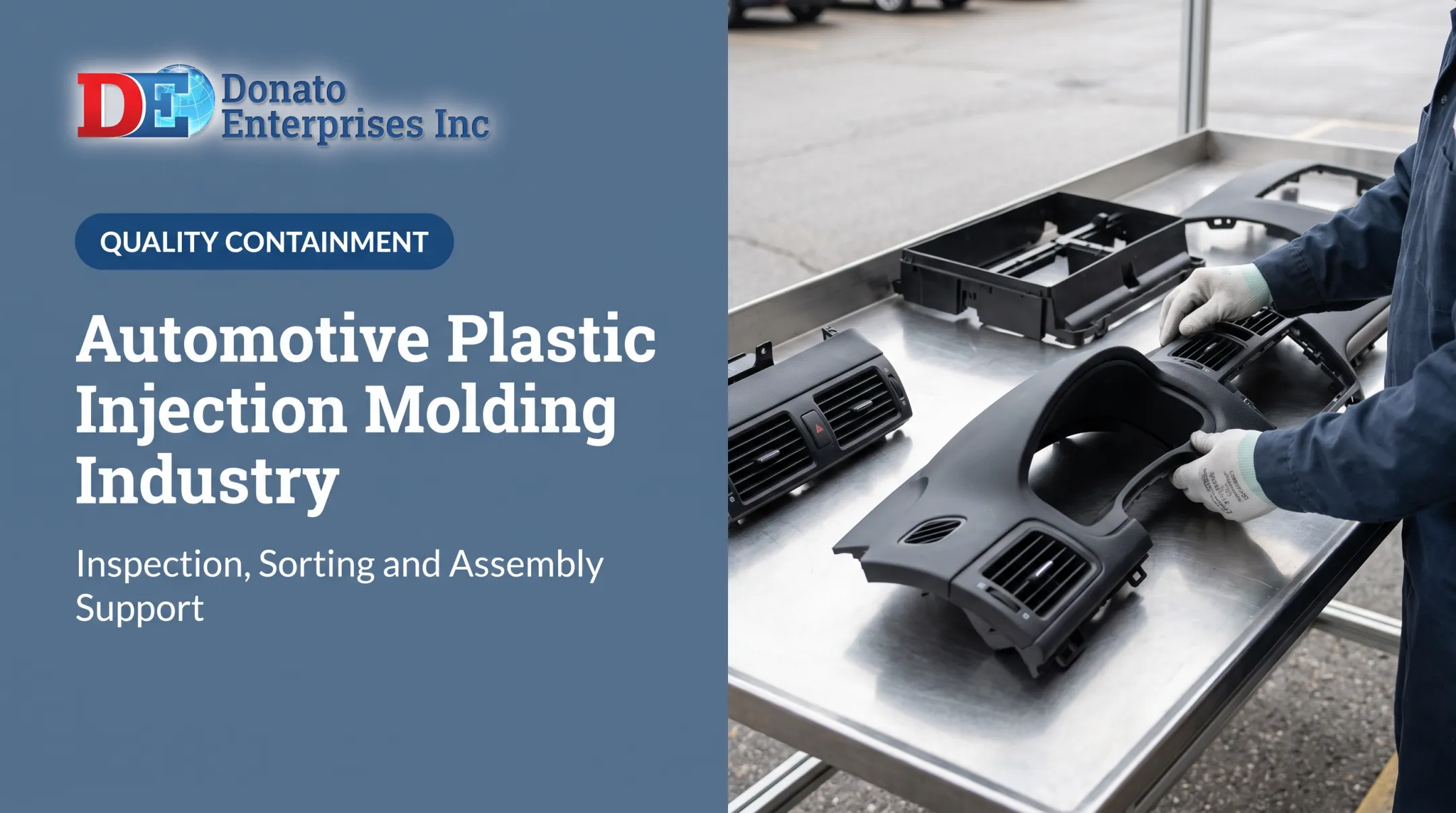
Even well-run molding can ship parts that need sorting, cosmetic inspection, flash removal, deburring, cleaning, assembly, kitting, or safe-launch support. Document and control these operations so they don't add damage, contamination, dimensional change, or traceability gaps.
GM's October 2025 requirements, for example, replace GP-12 with Early Production Containment during launch until the assigned SQE releases it.
How to Choose a Precision Molding Partner
Technical and Quality Capabilities to Verify
Ask suppliers about:
- Material expertise and tooling design
- Machine repeatability and process development
- Measurement equipment and validation methods
- Traceability, maintenance, and corrective-action systems
Request experience with similar materials, geometries, tolerances, volumes, and regulatory or customer documentation. For automotive work, ask for evidence of APQP, Control Plan, PPAP, FMEA, SPC, and MSA use.
Questions to Answer Before Approving a Supplier
- Which dimensions are critical to function?
- What cosmetic conditions are acceptable?
- What resin specification and volume apply?
- Who owns the tooling? Ownership is contract-specific; AAM's 2020 guideline, for instance, requires ownership identification on tooling.
- What inspection records, packaging, and change control will you get?
- What are the lead times and escalation paths?
Also confirm how the supplier handles trial parts, engineering changes, deviations, rejected product, rework, and production interruptions.
A molding partner decision should also cover secondary capacity. Inspection spills, flash work, and packaging often need outside support so the press stays on molding.
Donato Enterprises as a Complementary Manufacturing-Support Provider
Donato Enterprises is a family-owned manufacturing-support company founded in 1996 and based in Memphis, Michigan. It is not a primary injection molder. It supports molders and their customers after the press.
Its services include:
- Parts inspection, including PPAP, GP-12, and safe-launch inspection
- Dimensional sorting with calipers and gages, plus containment
- Flash removal, cleaning, and deburring
- Assembly, kitting, and packaging on customer-supplied parts
The company reports 99.965% sort accuracy and 100% on-time delivery on its inspection service. Those results matter for plastic molders, automotive suppliers, and launch programs that need reliable downstream capacity.
If you face a molding-quality spill, suspect parts, labor-intensive secondary work, or outsourced packaging needs, contact Donato Enterprises at 810-392-7678. Confirm service fit and turnaround against your program requirements.
Frequently Asked Questions
What is the best plastic for precision injection molding?
It depends on the part's mechanical, thermal, chemical, electrical, dimensional, appearance, and regulatory needs. Check current manufacturer data and validate the grade in your application.
What are the different types of plastic molding used in injection molding?
Conventional molding suits simple parts. Insert molding and overmolding combine plastic with inserts or substrates, two-shot molding combines materials, and micro-molding makes very small components.
What is precision injection molding?
It is molding with tight dimensional control and repeatability, using specialized tooling, stable processing, material knowledge, and inspection. No single universal tolerance defines it.
Can AI design an injection mold?
AI can assist with design analysis, simulation, and iteration. Experienced engineers still must validate tooling, resin behavior, manufacturability, and quality results.
How do you measure quality in precision plastic injection molding?
Through dimensional inspection, gauge repeatability, visual checks, process monitoring, capability studies, and traceability, judged against application-specific acceptance criteria.
Does every plastic part need precision injection molding?
No. It fits parts where tight control or repeatability affects function, assembly, safety, or customer requirements. Simpler parts may not justify the added tooling and process controls.