The labor squeeze is real. The Deloitte and Manufacturing Institute study projects up to 3.8 million manufacturing jobs created between 2024 and 2033, with as many as 1.9 million potentially unfilled.
Outsourced assembly and manufacturing services mean a third-party provider handles defined production work, such as assembly, inspection, rework, or packaging. It doesn't necessarily build the whole product. This guide covers what you can outsource, the tradeoffs, what a quote needs, and how to evaluate a provider.
Key Takeaways
- Outsourcing can be one secondary operation or a broader assembly program.
- Match the provider to your materials, part complexity, volume, and quality controls.
- Drawings, BOMs, work instructions, and samples prevent quote misunderstandings.
- Judge total cost, quality risk, traceability, and scalability, not just labor rate.
What Are Outsourced Assembly and Manufacturing Services?
Outsourcing means hiring an outside company to perform defined production work while you keep control of requirements, specifications, and acceptance criteria.
Contract Manufacturing vs. Assembly and Support
A contract manufacturer typically makes a specified part or complete product to the OEM's specifications. An assembly or support provider performs a discrete operation instead:
- Subassembly
- Inspection and sorting
- Deburring and cleaning
- Rework
- Packaging and kitting
The scopes overlap, so don't assume. "Manufacturing" is an umbrella term. Name the exact operation you need rather than assuming a provider offers machining, molding, stamping, casting, or full fabrication.
Who Uses These Services
- Tier 1 and Tier 2 automotive suppliers facing quality spills
- Metal stamping houses that want sorting and deburring off their press floor
- Plastic injection molders and foam producers needing flash removal or kitting
- Die casters and foundries outsourcing casting cleanup
- Manufacturers in new-program launch or safe-launch windows
What Services Can Be Outsourced?
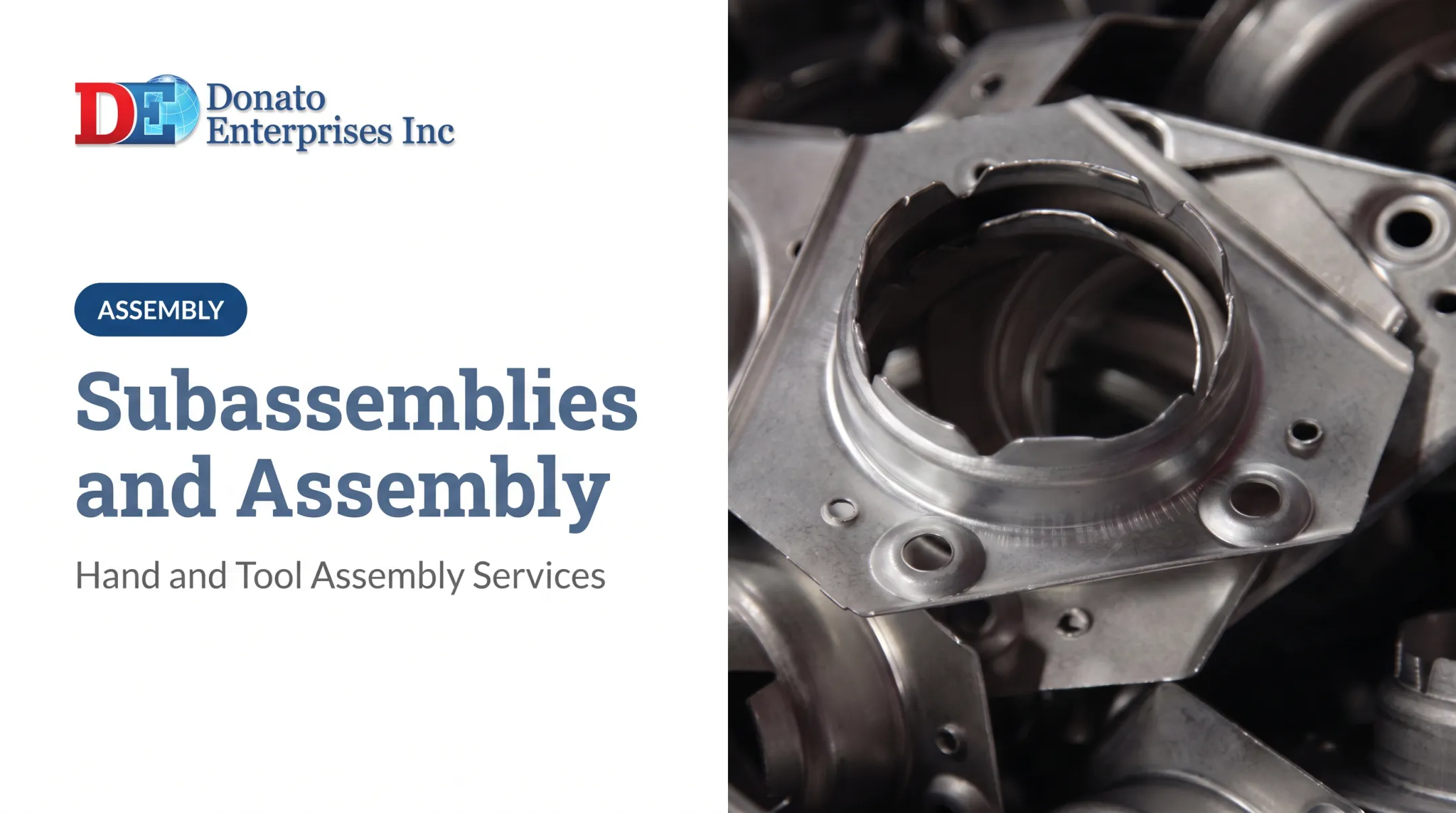
Assembly and Subassembly
Outsourced assembly is typically labor-intensive build-to-print work guided by documented work instructions. ESMO describes build-to-print as making assemblies to customer drawings with no design changes. Examples include gluing, adding springs or clips, snapping parts together, fastening, and spot-welding.
Inspection, Sorting, and Containment
This covers suspect parts, customer complaints, quality spills, and launch support. Requirements vary by customer.
Leggett & Platt, for example, defines CS1 as containment plus redundant 100% inspection, and CS2 as adding a second inspection by a third-party sorter. Those are one customer's rules, not universal definitions. GM's Early Production Containment (GP-12) is likewise GM-specific.

Secondary Operations
- Deburring and cleaning
- Flash removal on molded parts
- Cosmetic sorting
- Preparing cast, stamped, or molded parts for the next stage
Packaging, Repackaging, and Kitting
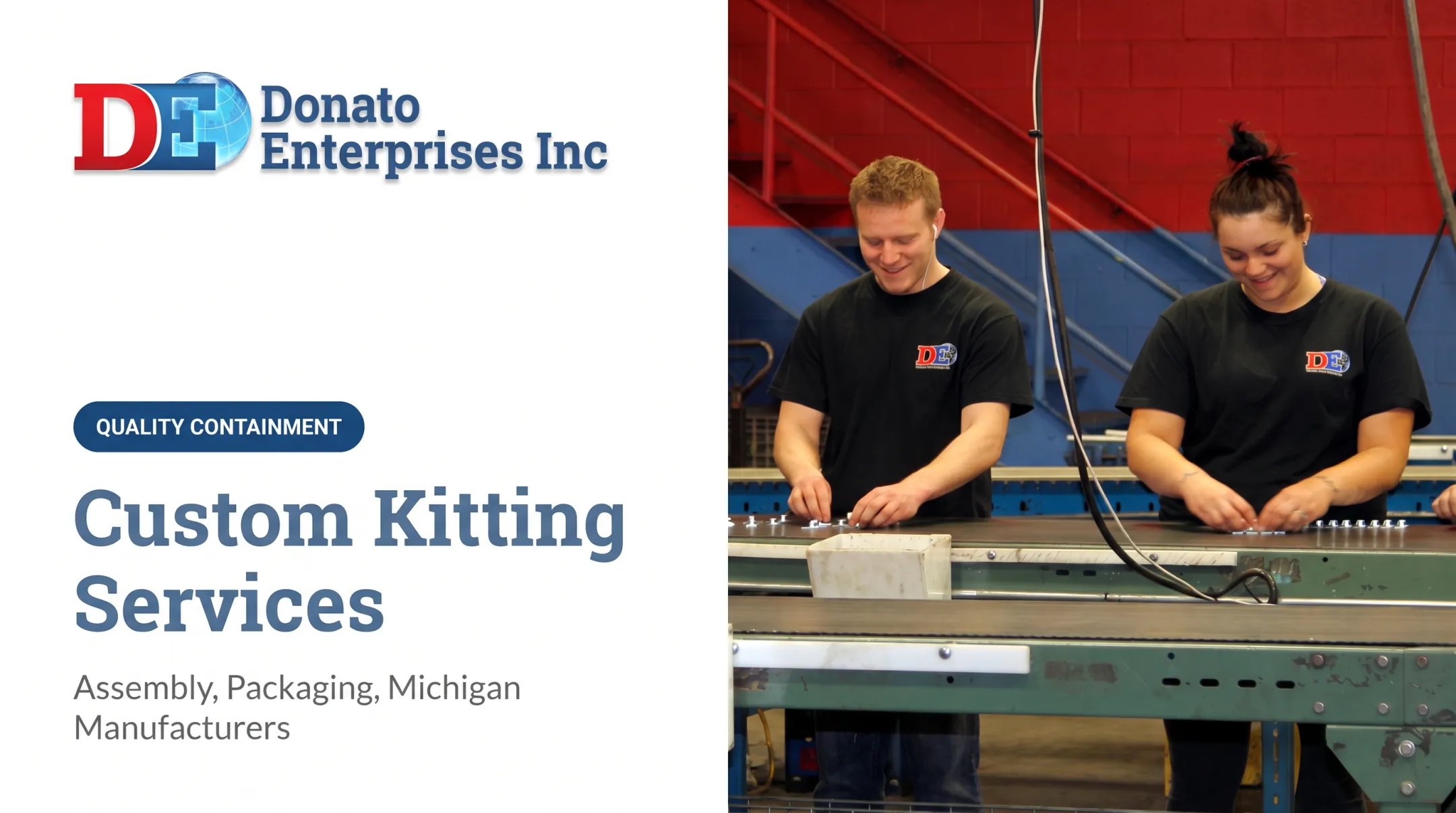
An outside provider can group components into ready-to-use kits, label them, and pack finished sets when you lack labor, floor space, or throughput.
Define the Scope Limits
Spell out in writing:
- Which activities the provider performs
- Which materials and processes stay with you
- Who owns the inventory
- Whether sourcing, testing, storage, or shipment is included
What Are the Benefits and Tradeoffs of Outsourcing?
Benefits
Outsourcing can reduce the need for dedicated equipment, temporary labor, and floor space. It also keeps presses, molding cells, and machining centers on primary production.
Labor cost is part of that equation. BLS reported private manufacturing employer compensation at $48.62 per hour in June 2026, including benefits. That figure is a national cost benchmark, not an outsourcing savings estimate.
Specialized teams can also protect shipments during temporary capacity crunches.
Tradeoffs
Common tradeoffs include:
- Transportation and handling costs
- Communication gaps
- Intellectual-property concerns
- Traceability requirements (Cummins, for example, requires component traceability and barcode readability from suppliers)
- Dependence on a third party
- Inconsistent results if work instructions and escalation procedures are incomplete
Most of these risks shrink with clear documentation and a defined escalation path.
How Does the Outsourcing Process Work?
1. Define the Scope
Before requesting quotes, gather the details a provider needs to bid accurately:
- Part numbers
- Annual and current volumes
- Turnaround requirements
- Process steps
- Quality standards, defect definitions, and acceptance criteria
- Inspection frequency
2. Assemble the RFQ Package
A strong package includes:
- BOMs and engineering drawings
- Tolerances and finish requirements
- 3D models, photos, and samples
- Work instructions
- Packaging, labeling, and testing specifications
- Material-ownership details
FWM's RFQ guide also recommends describing the current issue you're trying to solve.
3. Provider Review
A good provider does the following before quoting:
- Confirms capabilities against your scope
- States assumptions clearly
- Estimates labor and materials
- Outlines available capacity
- Clarifies exclusions
4. Pilot First
Before full production, run a controlled pilot with:
- First-piece approval and sample validation
- Operator training
- Documented inspection steps
- Traceability and nonconformance handling
- An agreed escalation path

5. Manage the Program
Review these metrics on a set schedule:
- On-time delivery
- Defect escapes and rework
- Turnaround time
- Inventory accuracy
- Containment effectiveness
Benchmarks are customer-specific. Cummins, for instance, targets zero defect PPM. No universal on-time delivery percentage exists, so set your own targets with the provider.
How to Choose an Outsourced Assembly and Manufacturing Partner
Technical Fit
Confirm the partner has handled work like yours:
- Similar materials and part types
- Matching assembly methods and volumes
- Known quality risks and packaging needs
- Automotive or industrial customer requirements
Quality and Operational Controls
Ask about:
- Inspection equipment
- Documented work instructions
- Employee training
- Lot traceability
- Corrective-action procedures
- Containment response
- Evidence of comparable work
The Full Commercial Picture
Compare the full commercial terms, not just the unit price:
- Quote assumptions, labor, and material inclusions
- Transportation, minimum volumes, and lead times
- Surge capacity and contingency plans
- Confidentiality, inventory responsibility, and communication frequency

An Example: Donato Enterprises
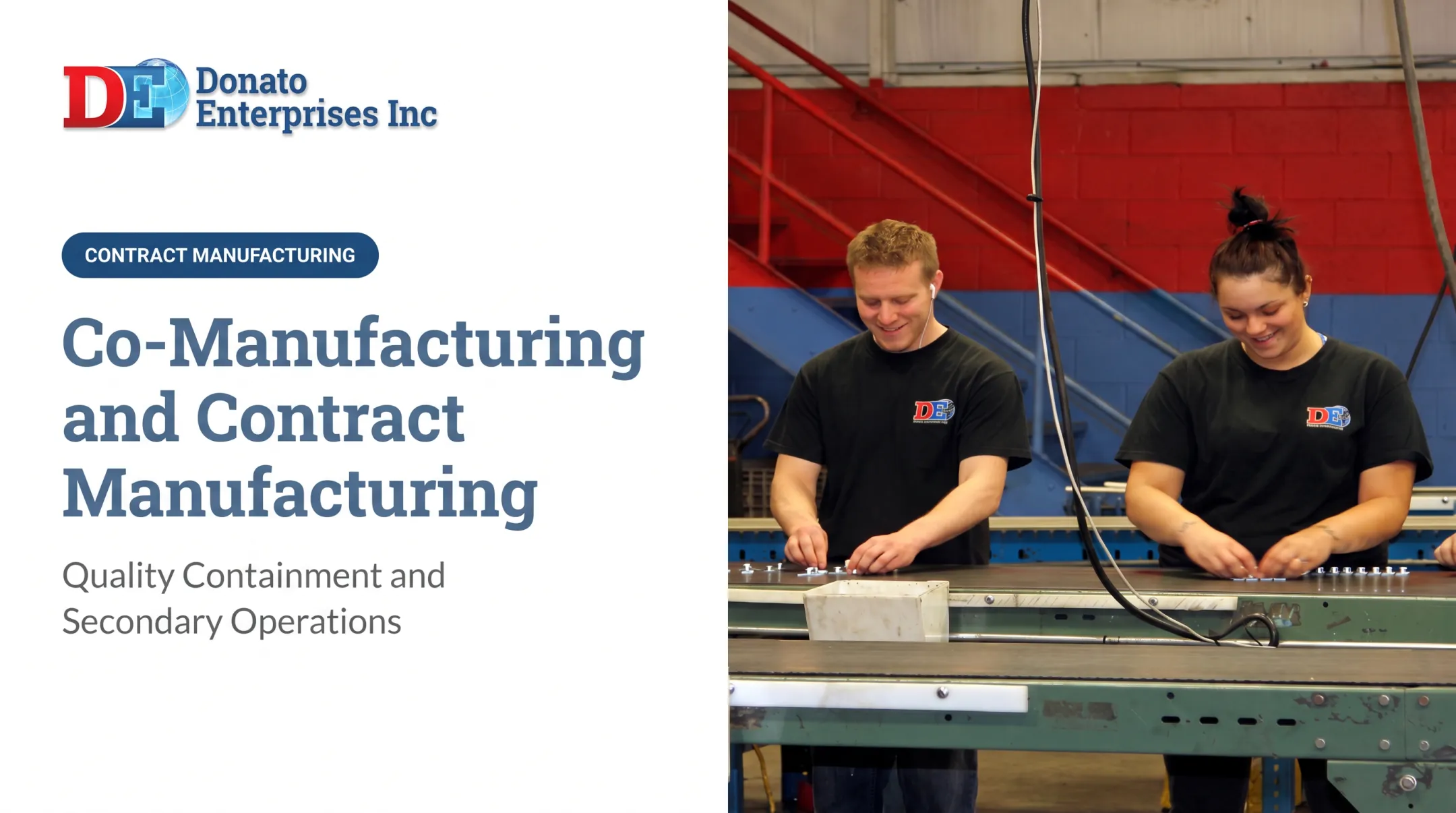
Donato Enterprises, Inc., a family-owned provider in Memphis, Michigan, offers inspection, sorting, assembly, packaging, cleaning, deburring, kitting, parts rework, and quality assurance. Founded in 1996, it works on customer-supplied parts and serves automotive and other manufacturers across Eastern and Central Michigan, including Grand Rapids and Branch County.
Its work is built on proprietary inspection and containment processes. It applies QSB, ISO, and GP-12 guidelines and PPAP package verification, and reports 99.965% sorting effectiveness (the company's own figure).
That scope fits defined automotive and manufacturing-support work, not full-fabrication contract manufacturing. Quotes are custom; reach the team at 810-392-7678.
Frequently Asked Questions
What is outsourced manufacturing?
It means using an external provider for specified production, assembly, inspection, finishing, packaging, or related work. Scope ranges from a single operation to a broader contract-manufacturing program.
What does "outsource" mean in simple terms?
You pay another qualified company to do a task you could otherwise handle internally. You typically keep responsibility for requirements, specifications, and final acceptance.
What is OSAT (outsourced semiconductor assembly and test)?
OSAT refers to third-party providers of integrated-circuit packaging and testing. It's a semiconductor term, distinct from industrial assembly, sorting, and packaging support.
What are the benefits of outsourced assembly and manufacturing services?
Potential benefits include skilled labor, flexible capacity, specialized processes, quality support, a lighter internal workload, and faster response to launch demands. Results depend on provider fit and process control.
What information should I provide to an outsourced assembly provider?
Provide drawings, BOMs, samples, volumes, tolerances, work instructions, quality criteria, packaging requirements, delivery schedule, and any testing or traceability expectations.