Even large producers feel it. Toyota describes certified inspectors running a 1,500-point check on finished vehicles, a company-specific example of how much verification can pile up at the end of a line.
This article defines subassemblies, explains how they differ from final assembly, walks through the production workflow, and shows when outsourcing can improve quality, capacity, and delivery.
Key Takeaways
- A subassembly is a functional unit built from multiple parts before it goes into a larger product.
- Final assembly combines modules and individual parts into the completed product.
- Kitting, early inspection, and standard work simplify the final line and expose defects sooner.
- Consider outsourcing when labor, floor space, or process capability runs short.
What Are Subassemblies and Assembly?
NIST defines a subassembly as two or more parts forming a portion of an assembly, or a unit replaceable as a whole that still contains individually replaceable parts. In practice, a subassembly has its own work instructions, material requirements, inspection criteria, and a defined place in the bill of materials (BOM).
"Assembly" has three common meanings:
- The act of joining parts
- The work area where joining happens
- The finished unit that is ready for its next stage or for the customer
The product hierarchy
Raw materials and individual components sit at the bottom. They combine into subassemblies, which combine into the final assembly. A molded plastic housing that receives a bracket, a clip, and a harness is a simple example. The finished housing is a subassembly of the larger product.
A single purchased part or a piece of raw stock is not a subassembly. A subassembly requires multiple operations and is meant to be integrated into a parent product.
Why manufacturers define them separately
- Work is easier to allocate across people and sites
- BOMs become clearer
- Each module gets independent quality checks
- Kitting gets simpler
- Labor-intensive operations are easier to control
Subassembly vs. Assembly: Key Differences
| Subassembly | Final assembly | |
|---|---|---|
| Position | Intermediate step | End of the build |
| Purpose | Ready-to-install module | Complete product |
| Scope | One function or group of parts | Modules plus loose parts |
| Output | Built, inspected, packaged, stored | Shipped or used |
A subassembly can be built, inspected, packaged, and held in storage before final assembly begins. Final assembly pulls those modules together with remaining components.
The same item can be both
Level in the product structure decides the label. According to a U.S. patent application, a supplier assembles solenoids, a module body, and a control module into a transmission electro-hydraulic control module. That unit is an assembly for the supplier. The vehicle maker installs it into a transmission, so it becomes a subassembly, and the transmission is itself a subassembly of the vehicle.

What subassembly work includes
Subassembly work is not finished-product manufacturing. It can include:
- Fastening, pressing, and joining
- Wiring and gluing
- Deburring and cleaning
- Inspection and functional checks
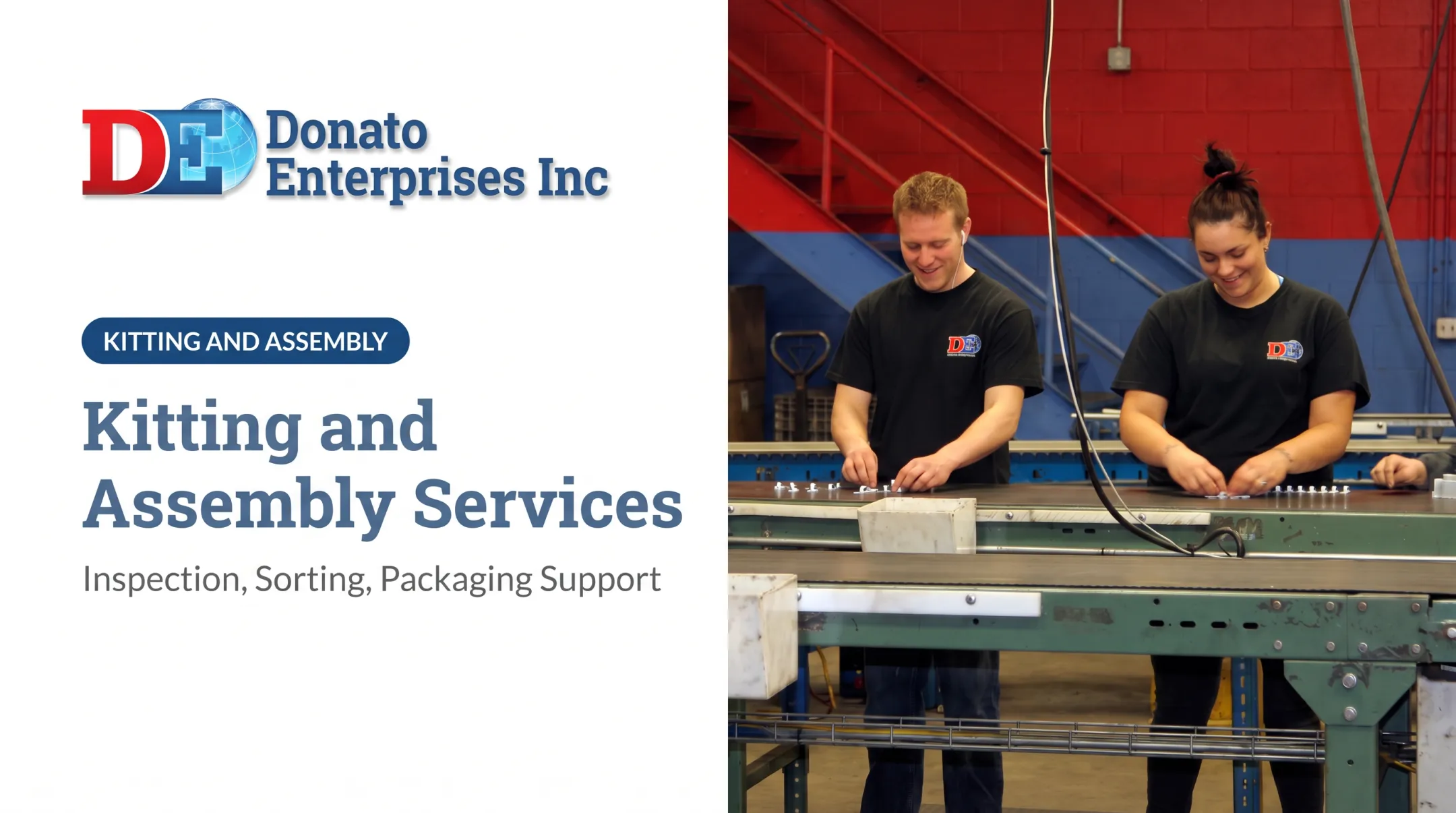
- Kitting and packaging
How the Subassembly and Assembly Process Works
Exact steps vary by product, and not every method applies to every job. A typical workflow looks like this:
- Define the requirements. Gather drawings, specifications, the BOM, routing, quality requirements, acceptance criteria, and how the module interfaces with its parent product. The BOM lists components and quantities; the routing sets the sequence of operations.
- Prepare and kit components. Verify incoming parts, separate correct quantities, and identify revision-controlled materials. NIST describes kitting as delivering the exact parts needed for one assembly object to the station, so operators build without searching or mixing parts.
- Build. Apply the operations the product calls for, such as fastening, fitting, gluing, adding clips or springs, snapping parts together, deburring, cleaning, or rework.
- Inspect and test. Run dimensional and visual checks, fit verification, torque checks where applicable, and functional tests. Document nonconforming parts.
- Verify, label, and stage. Complete final verification, label, package, and deliver to the next operation.

Traceability closes the loop. Clear identification and quantity verification keep wrong parts and incomplete modules off the final line.
At Donato Enterprises, for example, each new package is verified against the quantity outlined in the customer's PPAP, and packaging work can include barcode scanning by teams with Plex ERP experience.
Benefits of Using Subassemblies
Parallel work and less line congestion
Prebuilding modules lets compatible work happen at the same time, so final stations handle fewer parts. Kitting helps too.
A Chalmers study at Saab Automobile found significantly shorter parts-fetching time with kitting than with continuous supply. It did not quantify a whole-line gain, so treat the benefit as better parts presentation, not a guaranteed cycle-time cut.
Earlier defect detection
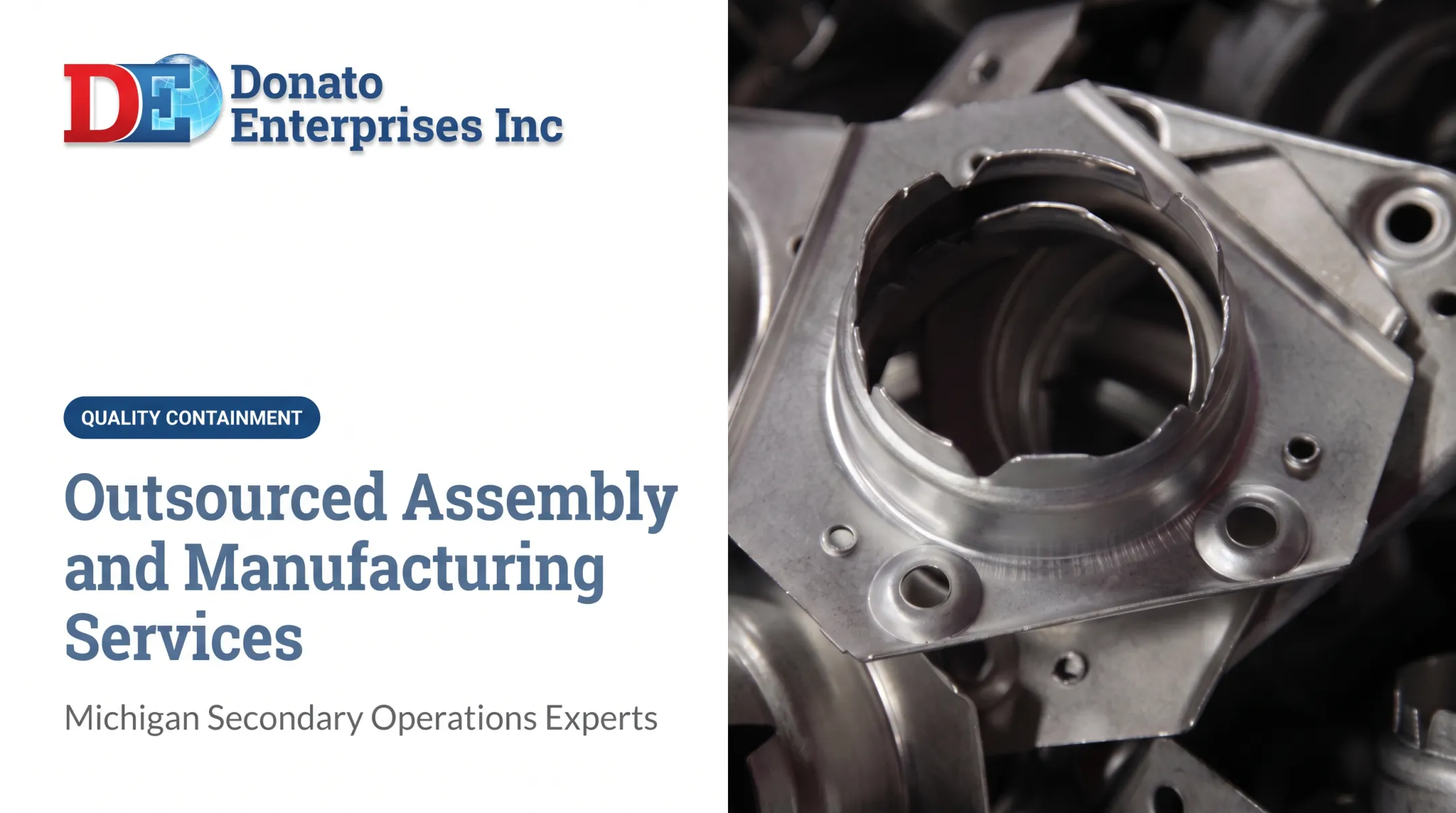
Inspecting at the subassembly stage catches burrs, cosmetic flaws, missing components, and assembly errors before more labor and material are added. Containing a nonconformance at this level is cheaper than discovering it at the customer. ASQ separates internal failure costs (defects found before shipment) from external ones such as warranty claims and returns.

Operational gains
- Repeatable work instructions across shifts
- Easier training with standardized work and job-instruction sheets
- Better workstation organization and simpler material handling
- More production flexibility
- Less pressure on your floor space and headcount
The gains above improve parts presentation and standardization. They do not prove a universal drop in total labor, lead time, or defects, so measure results on your own process.
Applications, Outsourcing, and Partner Selection
Where subassembly support fits
- Automotive component modules: gluing, clips, springs, screws, snap-fit parts, spot welding
- Stamped parts: deburring and 100% sorting
- Plastic and foam components: flash removal, cosmetic sorting, subassembly, kitting
- Die-cast and foundry parts: trimming, cleanup, and inspection of raw castings
- Launches: third-party inspection during safe launch or early production containment
Terminology varies by customer. GM's October 2025 requirements, for instance, replaced GP-12 with Early Production Containment, so check the current supplier-quality manual for your OEM.
When outsourcing makes sense
Look at outsourcing when you face:
- A quality spill, suspect-part alert, or customer complaint
- A production surge or new-program launch
- Constrained headcount or limited floor space
- Assembly work pulling skilled employees away from core operations
Labor context matters, but openings alone don't justify a decision. The BLS reported 584,000 manufacturing openings in its preliminary September 2026 data. Start with a documented gap in capacity or capability.

How to select a partner
NIST MEP advises learning a supplier's capabilities and asking about production capacity. Add these checks:
- Documented work instructions
- Inspection and containment processes
- Rework and deburring ability
- Clear communication and turnaround expectations
- Traceability and packaging controls
- Experience in similar manufacturing environments
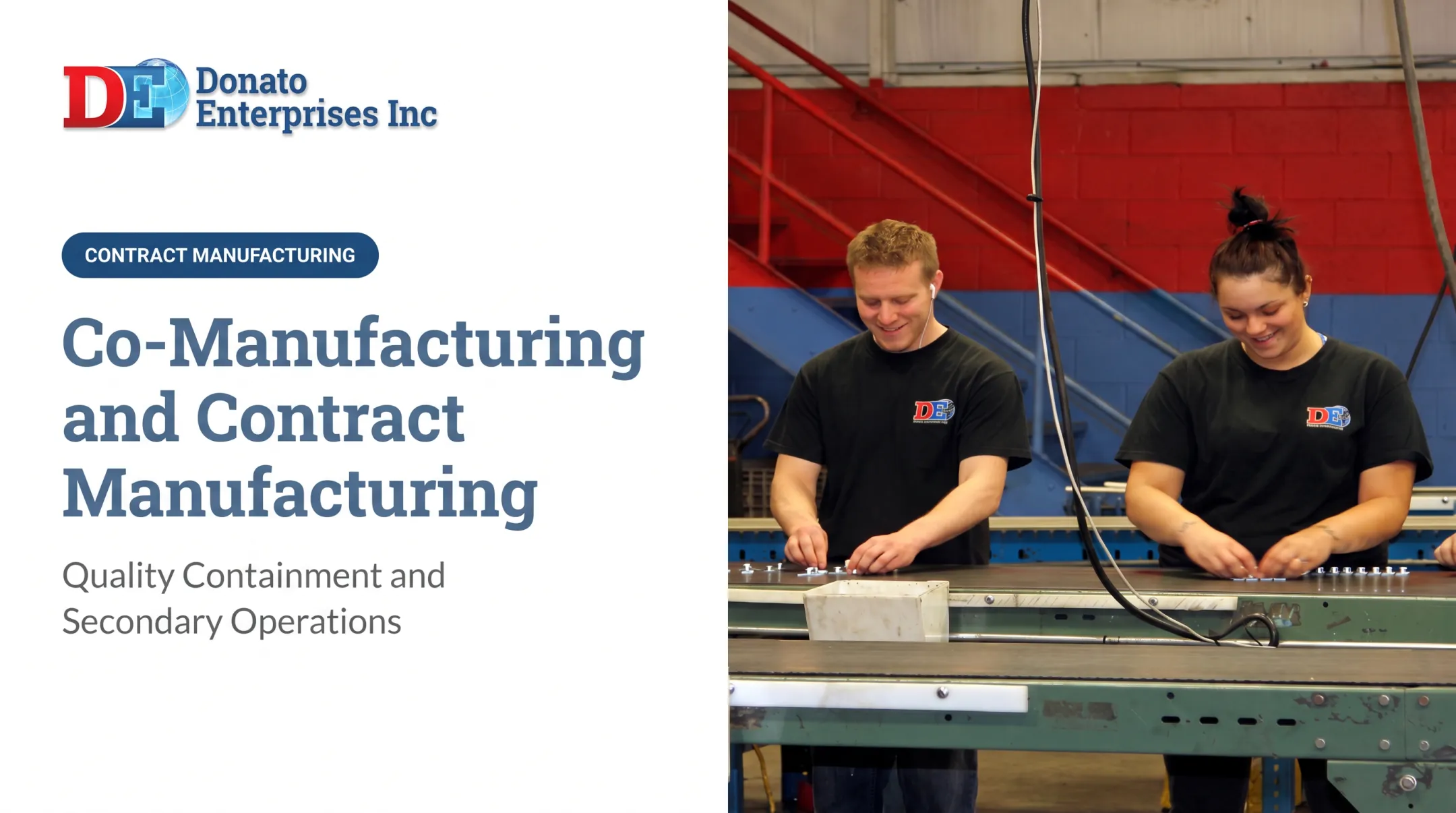
Donato Enterprises, a family-owned provider in Memphis, Michigan, is one option. It handles assembly, subassembly, kitting, packaging, cleaning, deburring, parts rework, inspection, and quality containment on customer-supplied parts. The company applies QSB, ISO, and GP-12 guidelines and reports 99.965% sort accuracy. It also reports 100% on-time delivery on its assembly and subassembly service. Quotes are project-based.

Frequently Asked Questions
What does sub-assembly mean?
A subassembly is a functional intermediate unit built from two or more components before it is integrated into a larger product.
What is the difference between assembly and subassembly?
Assembly is the broader joining process or the completed product. A subassembly is an intermediate module used within a larger assembly.
What is a sub-assembly example?
A wiring harness is a common one. Built from wires, connectors, and clips, it is later installed into a larger machine or vehicle.
What is a sub-assembly in a car?
Examples include transmissions, instrument panels, suspension modules, door systems, and wiring harnesses. Each is built separately and installed into the vehicle.
What is a sub assembler?
A sub assembler is a company or production cell that builds intermediate modules for a larger product. Outsourced sub assemblers add capacity and labor without tying up your floor.