Introduction
Joining isn't just the last step after molding. The wrong method can cause leaks, stress concentrations, cosmetic defects, rework, rejected parts, and late shipments.
The stakes can be high. A 2023 Ford Transit recall covered 1,159 potentially involved vehicles because a fuel-tank vent valve might not have been properly welded, according to NHTSA's recall report. The cause traced back to process control: an incorrectly installed thermocouple and an overheated platen.
This guide covers mechanical fastening, adhesive and solvent bonding, plastic welding, staking, overmolding, process selection, design for assembly, inspection, and outsourced assembly support.
Key Takeaways
- Match the joining method to resin, geometry, performance needs, volume, quality, and serviceability.
- Welding is one category of joining and doesn't suit every resin or joint.
- Design the joint, fixture, tooling, and inspection plan together.
- Outsourcing assembly, inspection, kitting, or containment keeps primary production running.
What Plastic Component Assembly and Joining Involves
Assembly vs. Joining
Assembly is the whole sequence: positioning, orienting, inserting, fastening, bonding, inspecting, and preparing parts for shipment. Joining is the specific operation that creates or secures the interface between components.
Plastic Material Categories
TWI describes thermoplastics as materials that soften when heated and solidify on cooling. Thermosets typically harden through heat or chemical action and don't remelt the same way. That difference decides whether welding is even an option.
Engineering plastics (PA, PPA, PBT, and POM are common families) are chosen for demanding mechanical, thermal, or chemical needs. Joining behavior is grade-specific:
- ABS and PMMA: suitable for ultrasonic welding.
- PC: some grades weld to PC/ABS or selected ABS grades.
- Nylon (PA): moisture can vaporize during ultrasonic welding and leave bubbles or a porous joint, so keep it dry.
- PP and PE: low surface energy makes adhesive wetting difficult.
- PEEK: can be welded by several processes, but its high melting temperature demands substantial focused energy.
Always confirm specifics against the resin supplier's datasheet.
Typical Manufacturing Applications
Applications include housings, covers, inserts, seals, subassemblies, foam-to-plastic parts, and kits. Each carries different priorities: appearance, leak resistance, vibration durability, disassembly, or repeatability at volume.
In automotive work, EWI documents these examples:
- Lamps: hot-plate, vibration, laser, and infrared welding.
- Coolant tanks and battery housings: hot-plate or infrared welding.
- Filter housings and manifolds: spin or vibration welding.
- Instrument panels and logos: staking.
- Door panels and glove boxes: ultrasonic spot welding and adhesives.
Common Methods for Joining Plastic Components
Mechanical Fastening
Screws, bolts, nuts, threaded inserts, rivets, pins, snap-fits, and integral molded features all retain parts through mechanical engagement. They suit assemblies that need service access, mixed materials, or simple tooling.
The risks are real:
- Localized stress around fasteners
- Loosening under vibration
- Cracking at bosses or snap features
- Added part count
Adhesive and Solvent Bonding
Adhesives form a bond layer between parts. Compatible solvents soften the surfaces so they fuse or cure together. Success hinges on:
- Material compatibility (low-surface-energy plastics often need pretreatment)
- Cleaning and surface preparation
- Joint gap, clamping, and cure time
- Environmental exposure
Disassembly is difficult once cured. Even so, some adhesives are made for removable applications.
Plastic Welding
Welding joins compatible thermoplastic surfaces using heat from friction, an external source, or electromagnetic energy.
Per TWI's welding overview, ultrasonic weld times are typically under one second. Covestro reports a typical vibration-weld cycle of 4 to 15 seconds. These figures are source-specific, not guarantees.
- Ultrasonic: high-frequency vibration heats the joint. Energy directors and shear joints are common designs.
- Vibration: friction heating with parts clamped during cooling. Handles irregular shapes and leakproof joints.
- Spin: rotational friction for circular joints.
- Hot plate: heated surfaces melted and pressed together. Suits large, complex, or thin-walled parts.
- Infrared: non-contact radiant heating.
- Laser: energy passes through one part and is absorbed by the other, with minimal flash.

Staking, Inserts, Overmolding, and Two-Shot Assembly
Thermal or ultrasonic staking softens and reshapes a molded post to capture an insert or mating component. It creates a mechanical interlock at discrete points, so it fits where a continuous seal isn't needed.
Overmolding and two-shot molding integrate a second material or component into the part. Design features, tooling, and material compatibility determine whether you get a mechanical lock or a material bond. Review the tooling approach early.
Comparing Methods by Application Requirements
Universal rankings for strength, cost, or seal performance aren't reliable across applications, so keep comparisons qualitative.
| Method | Permanence | Sealing / appearance | Notes |
|---|---|---|---|
| Mechanical | Removable by design | Varies with design | Adds parts and stress points |
| Adhesive | Usually permanent | Depends on prep and gap | Cure time, surface prep |
| Ultrasonic | Permanent fusion | Shear joints can seal hermetically | Very short cycles |
| Vibration | Permanent weld | Leakproof capable | Longer cycles |
| Laser | Permanent weld | Minimal flash | Needs transmissive/absorbing pair |
| Staking | Mechanical interlock | No continuous seal | Discrete points |
How to Choose the Right Joining Method
Start With Materials and Compatibility
Check resin family, fillers, additives, moisture sensitivity, surface energy, and melt behavior. Same-material welding is preferred. Dissimilar plastics need compatible molecular structure and similar melting temperatures.
Fillers matter too. Covestro's guide says higher glass-fiber content can increase horn wear and weaken the bond. Rely on datasheets and process trials, not assumptions.
Evaluate Geometry and Joint Design
Design the joint for the chosen process. Consider:
- Part size, wall thickness, and unsupported walls
- Access to the joint and fixture
- Tolerance stack-up and locating features
- Energy directors, weld posts, and overlap areas
- Adhesive gap
Define Functional and Service Requirements
List the demands on the joint:
- Load direction, impact, and vibration
- Pressure, temperature, and chemical exposure
- Fatigue and cosmetic standards
- Tamper resistance and future disassembly
Each maps to a joint type and a validation test, such as a pull test for retention or a leak test for sealed housings.
Consider Volume, Automation, and Total Cost
Compare factors that shape total cost:
- Production volume and cycle time
- Labor content, tooling, and consumables
- Changeovers, maintenance, scrap, and downtime
The cheapest equipment can carry the highest total cost of ownership. Low volumes may favor hand assembly and adhesives. High volumes justify automated welding.
Use a Process-Neutral Validation Plan
- Screen every compatible method.
- Run representative samples or a pilot build.
- Set measurable acceptance criteria.
- Review results against drawings, specifications, and standards.
- Bring in the equipment or assembly partner before the design is final.

Know the limits of standards. ASTM D3163 covers comparative lap-shear testing of bonded rigid plastics, and ASTM cautions that a single-lap shear value is not an allowable design stress for a different structure.
Design and Quality Controls for Reliable Assemblies
Design for Assembly and Manufacturability
- Consolidate parts where possible.
- Mold in locating features.
- Control clearances and support the joint.
- Reduce fastener count.
- Keep joining surfaces accessible.
Avoid sharp transitions and stress concentrations. Avoid features that make inspection or rework difficult.
Control Surface Preparation, Fixtures, and Process Parameters
- Clean and dry parts, and prevent recontamination after pretreatment
- Hold alignment and clamping with repeatable fixtures
- Lock down heat, vibration, cure, and cooling settings in a defined process window
Variation shrinks when those windows are controlled and documented.
Build Inspection Into the Process
- Incoming: material condition, moisture, dimensions.
- In-process: alignment, adhesive application, weld or stake appearance.
- Final: visual and dimensional checks, functional or pull testing, and pressure or leak testing where required.
- Destructive: validation when the application justifies it.
Identify Defects and Establish Disposition Rules
Common defects to watch for include:
- Incomplete fusion or weak bonds
- Voids, flash, and whitening
- Cracks, distortion, and misalignment
- Contamination, damaged inserts, and uncured adhesive
When operators find a suspect part, they should:
- Segregate it immediately.
- Document the defect.
- Decide whether it's reworkable.
- Feed findings back to prevent recurrence.

Maintain Traceability and Containment
Use lot identification, work instructions, inspection records, station traceability, and escalation plans. These support safe-launch programs, customer complaints, and quality-spill containment.
Requirements vary by customer. AGS Automotive's supplier manual, for example, defines CS1 as 100% supplier inspection and CS2 as 100% third-party inspection, and those are customer-specific definitions.
When to Outsource Plastic Component Assembly
Recognize When Outside Support Is Practical
Outside help makes sense during:
- A new product launch or safe-launch window
- A customer complaint or suspect-part alert
- A temporary labor shortage
- High-volume subassembly
- Limited floor space
- Labor-intensive inspection or packaging
Labor pressure is broad. Deloitte projects US manufacturing could need as many as 3.8 million additional workers between 2024 and 2033. That is a forecast, not proof of outsourcing savings.
Evaluate the Supplier Before Sending Work
Ask about:
- Experience with your material and assembly type
- Fixtures and equipment
- Inspection and containment procedures
- Documentation and traceability
- Capacity and turnaround
- Packaging controls and confidentiality terms
- Rework controls that keep good and suspect material separate

Relevant Manufacturing-Support Option
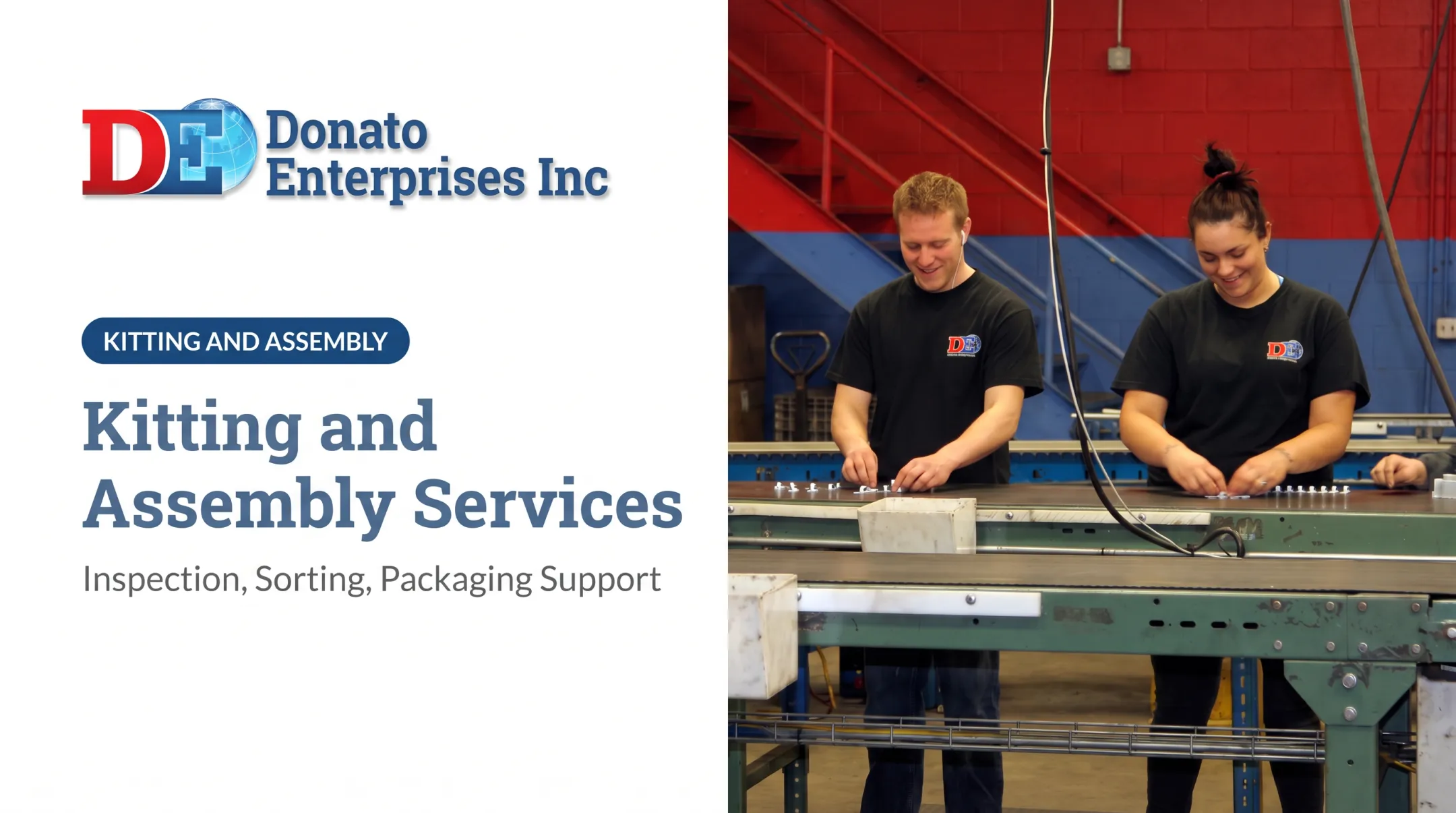
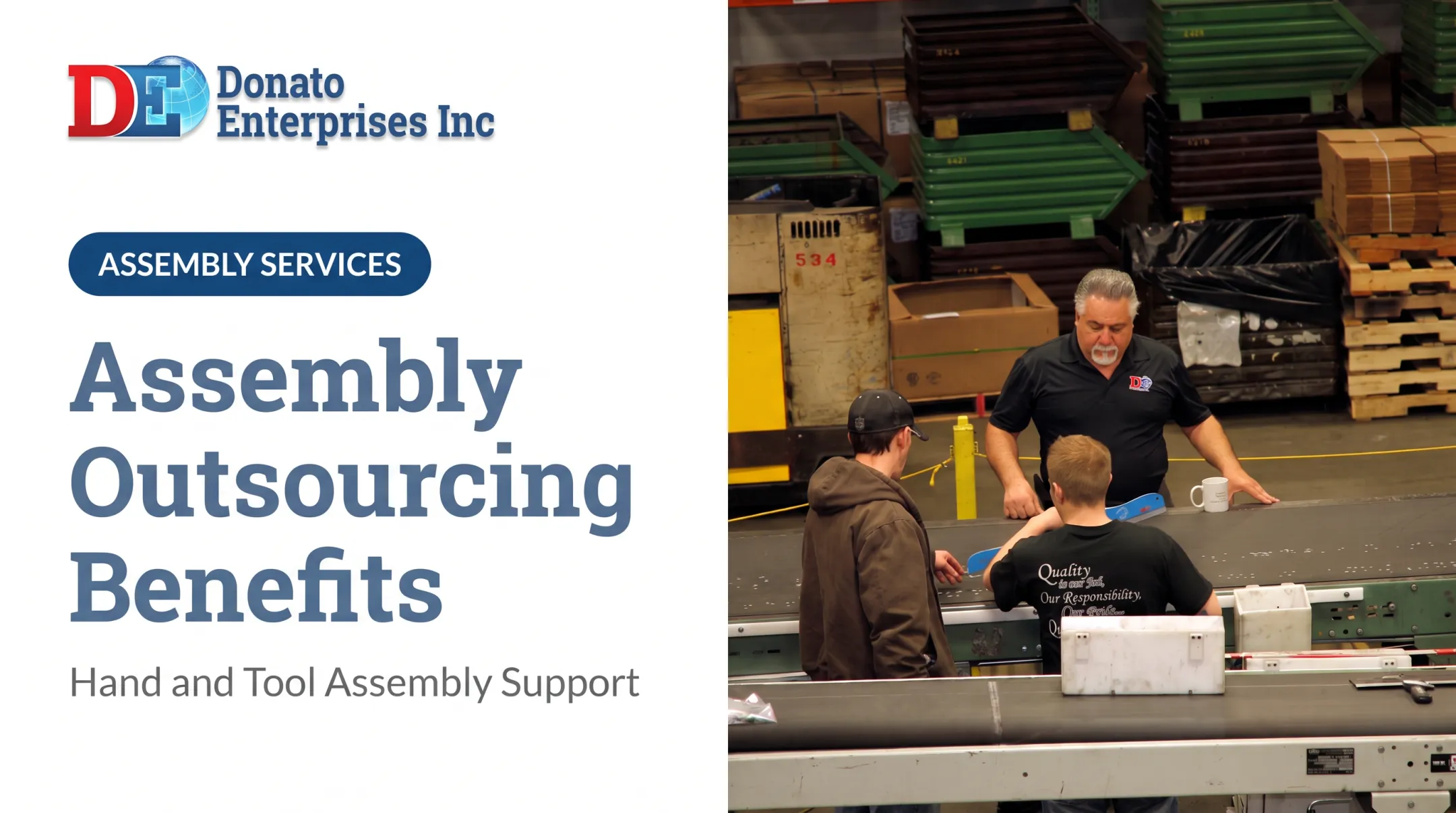
Donato Enterprises, Inc. is a family-owned provider in Memphis, Michigan. It supports automotive and other manufacturers with assembly, parts rework, inspection, sorting, packaging, kitting, cleaning, deburring, and quality containment.
Documented assembly work includes:
- Foam-to-plastic assembly
- Clips on plastic components
- Tight-tolerance plastic parts
- Hand gluing and heat sealing
Donato's inspection services follow PPAP, GP-12, and safe-launch practices. The company reports 99.965% sort accuracy and 100% on-time delivery on its parts inspection service. It does not offer in-house plastic welding or joining-process qualifications, so use it for labor-intensive assembly, inspection, and containment around your primary process.
To discuss your drawings, volumes, inspection requirements, packaging, and delivery expectations, call 810-392-7678. Note that messages sent through the website contact form are not confidential, so share sensitive drawings by phone first.
Conclusion
Reliable plastic assembly starts with a process-neutral review of materials, geometry, performance, production economics, and quality requirements. No single method wins for every assembly.
Before requesting a feasibility review or quote, gather part drawings, resin information, expected volumes, acceptance criteria, and service requirements.
Frequently Asked Questions
How much does plastic fabrication cost?
Cost depends on material, part complexity, tooling, volume, joining method, labor, inspection, packaging, and rework. Fabrication cost is separate from assembly cost, and no reliable general price range exists.
What is plastic welding?
It is the controlled joining of compatible thermoplastic surfaces using heat from friction, vibration, or focused energy. Material compatibility and joint design determine whether the weld holds.
What plastics are used in engineering?
Common families include PA, PPA, PBT, POM, PEEK, and PPS. The right choice depends on strength, temperature, chemicals, wear, dimensional stability, cost, and joining needs. Check resin supplier datasheets.
What are the 7 main types of plastic?
The resin identification codes are 1 PET, 2 HDPE, 3 PVC, 4 LDPE, 5 PP, 6 PS, and 7 Other. They identify resin for recycling and don't describe engineering performance or joining compatibility.
Which plastic joining method is best for automotive components?
It depends on resin, geometry, load, sealing, appearance, volume, and customer specifications. Ultrasonic, vibration, thermal, adhesive, mechanical, and staking methods each fit different applications.
Can plastic component assembly be outsourced?
Yes. Subassembly, inspection, sorting, kitting, packaging, rework, and containment can all be outsourced when the supplier meets your documented quality, traceability, capacity, and delivery requirements.