Introduction
Automotive and manufacturing suppliers often struggle with kitting quotes that swing widely from one job to the next. There is no universal price. Final cost depends on component count, labor steps, packaging, inspection level, and how fast you need the kits.
This guide is for suppliers that outsource component kitting, assembly, packaging, inspection, rework, or production support. Pricing is project-specific. One published vendor page describes OEM Materials' pricing as reflecting the labor, materials, and processes each finished package requires.
Below you'll find what kitting includes, which cost drivers matter, how to compare quotes, and when outsourcing beats doing the work in-house.
Key Takeaways
- Compare fully scoped cost per completed kit, not an isolated labor rate.
- Count labor, materials, setup, quality control, storage, supervision, and rework.
- A clear BOM, work instructions, packaging spec, and volume forecast produce accurate quotes.
- Outsourcing pays off when labor, floor space, or quality resources are constrained.
What Are Kitting Services?
The ASCM Supply Chain Dictionary defines kitting as "the process of constructing and staging kits." A manufacturing kit is a set of components for a parent item, pulled from stock and prepared for movement to production. Kits also cover repair parts shipped together with an order.
Bundling is a commercial grouping of products. Kitting creates the physical package. Assembly goes further. BLS describes assemblers as workers who build finished products and the parts that go into them, which may involve joining, fitting, fastening, or tooling.
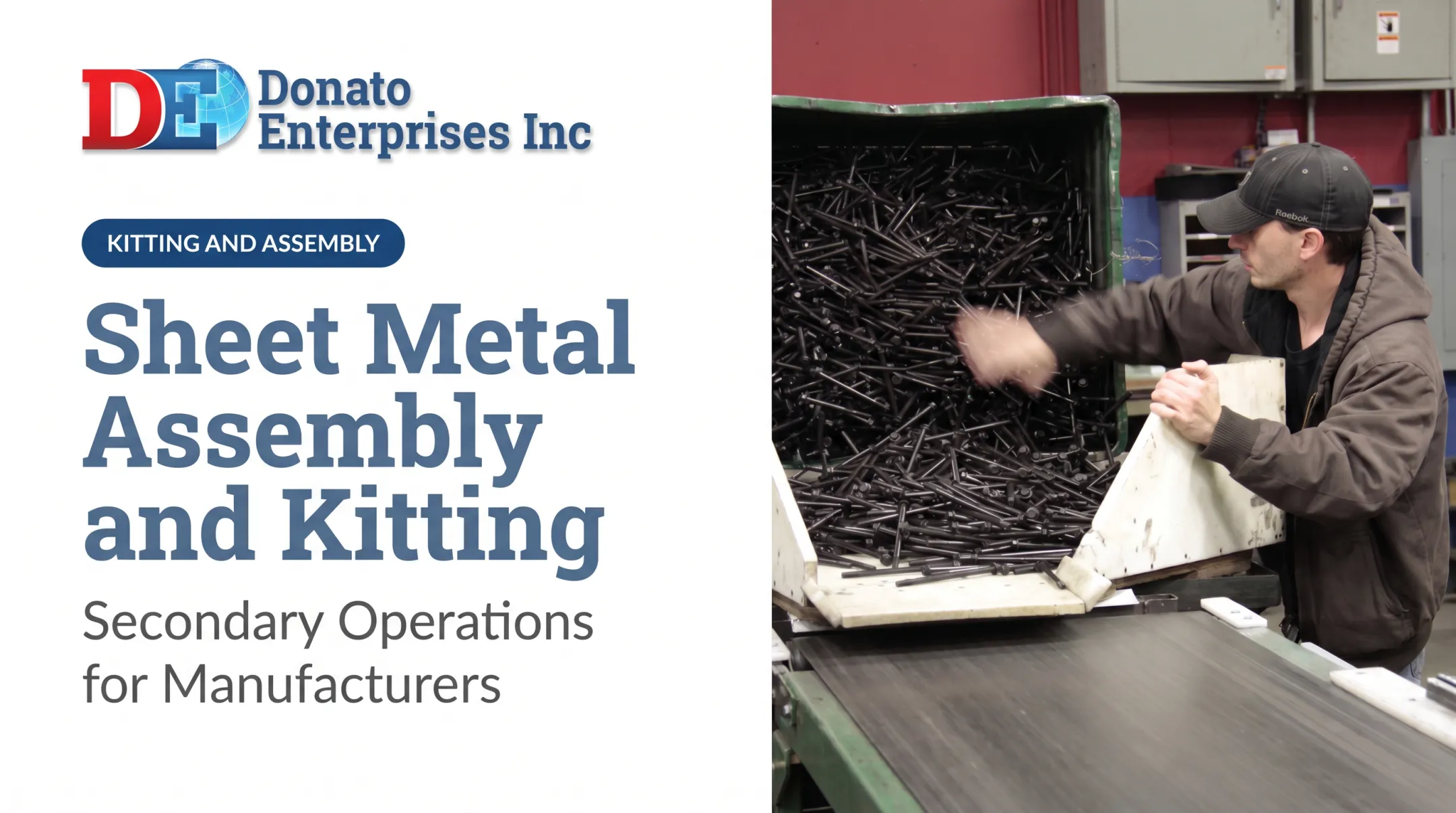
Industrial kitting often includes packaging, labeling, inspection, sorting, deburring, cleaning, or rework. Define that scope before comparing prices.
Types of manufacturing kitting work
American Steel & Aluminum offers a concrete example: kits holding cut, formed, and machined parts for a welded frame, or brackets for an enclosure. The agreed kit list normally specifies part numbers, revisions, quantities, and material or finish requirements from the BOM.
Your provider should document:
- Component SKUs and quantities
- Packaging sequence and labels
- Quality checks
- Lot or serial requirements
- Finished-kit identification
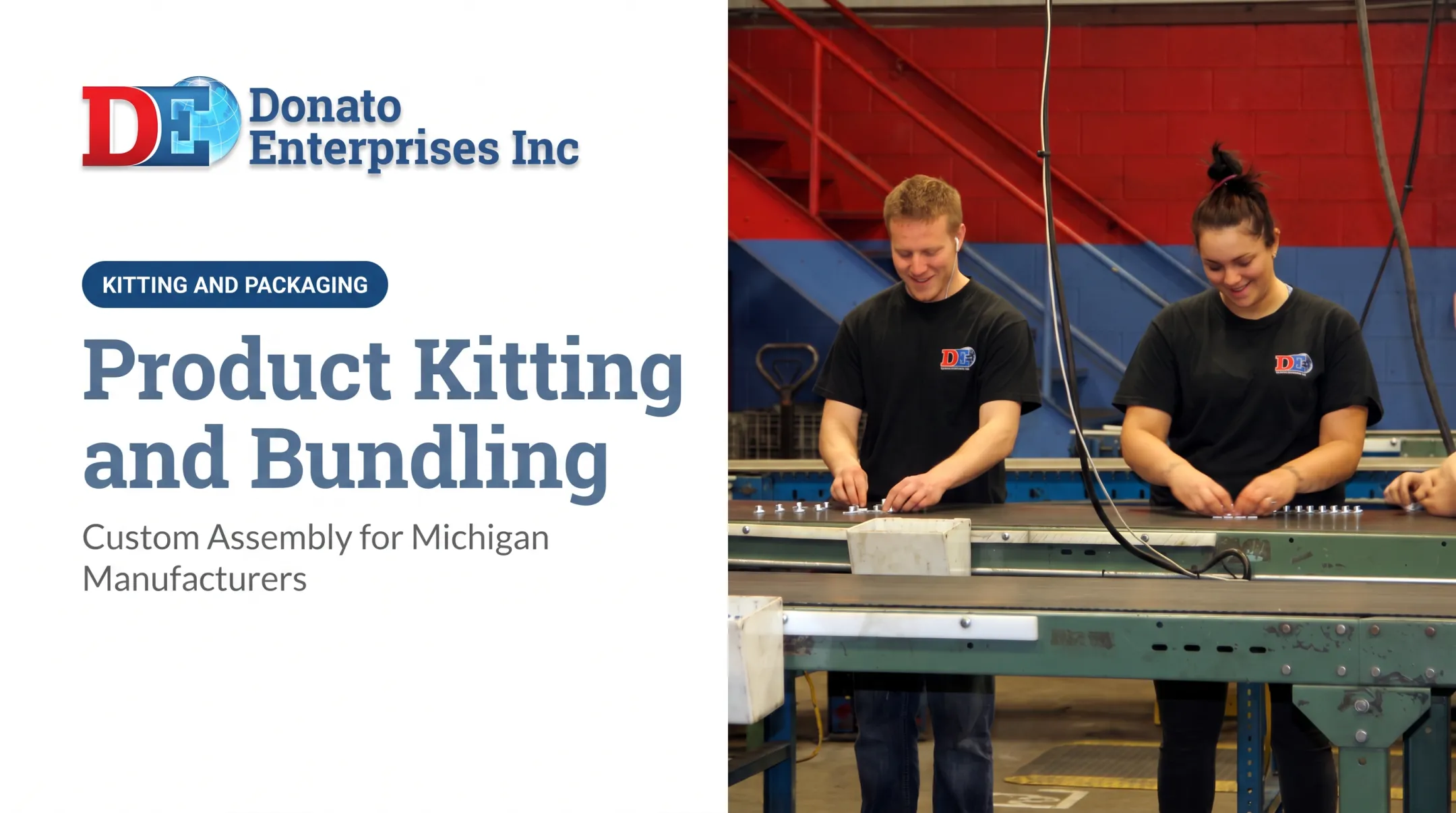
Donato Enterprises, for instance, verifies each new package against the quantity in the PPAP and checks labels against the part and package. The team also uses barcode scanners and works within Plex ERP.
When kitting becomes assembly
Adding tools, adhesives, fasteners, dimensional checks, functional tests, or multi-step joining moves a job from basic kitting into light assembly. Labor skill and quality controls change with it.
Ask for separate pricing on picking, packaging, assembly, inspection, and rework whenever they need different skills or process controls.
What Factors Determine Kitting Costs?
Labor and handling time
Labor covers receiving or staging components, picking to the BOM, counting, sorting, assembling, packaging, labeling, inspecting, and moving finished kits.
Use a fully loaded rate, not base wages. BLS reports private-industry employer compensation of $46.89 per hour in June 2026, with benefits making up 30.0% of that. That figure is broad and not specific to kitting. For context, hand packers and packagers earned a $17.44 median hourly wage in May 2025, and assemblers and fabricators earned $21.85.
Time per kit is the number to measure. Workstation layout, component presentation, batch size, changeovers, and documentation all raise or lower it.
Component count and complexity
Every added component means another pick, verification step, handling touch, error point, and inventory-control requirement.
Complexity goes beyond item count:
- Small or fragile parts
- Mixed component sizes
- Orientation requirements and tight tolerances
- Variable configurations
- Tools or fixtures
Credible, current U.S. price bands for simple, standard, and complex industrial kits are hard to pin down. Treat any published per-kit figure with suspicion and get a scope-based quote instead.
Packaging and materials
Packaging inputs include cartons, totes, polybags, inserts, labels, protective materials, dividers, returnable containers, and custom or retail-ready packaging.
Custom packaging, manual presentation rules, sustainability specs, or mid-program packaging changes add material cost, storage needs, setup time, and extra quality checks.
Quality control, traceability, and compliance
Scope grows with each requirement: visual inspection, count verification, barcode or label checks, lot tracking, serialization, first-piece approval, sampling, or 100% inspection.
Automotive programs raise the stakes. AGS Automotive's supplier manual separates CS1 (100% supplier inspection before shipment) from CS2 (100% inspection by an approved third party at supplier expense). It also requires GP-12 or an equivalent Safe Launch process for new launches and process changes. These are customer-specific requirements, not universal rules.
Poor quality is expensive. Pratt Miller's supplier manual lists supplier-responsible costs including sorting, scrap, rework, machine downtime, and line shutdown. ASQ's cost-of-quality framework groups these into prevention, appraisal, internal failure, and external failure.
Volume, scheduling, storage, and hidden charges
Recurring volume spreads setup and supervision across more kits. Small runs, frequent configuration changes, rush work, and seasonal spikes push per-kit prices up.
Watch for these line items:
- Component and finished-kit storage
- Receiving and staging
- Minimum charges
- Expedited labor and changeover fees
- Obsolete packaging
- Rework and inventory discrepancies
Ask whether each fee is charged per kit, component, run, hour, pallet, square foot, order, or monthly minimum. Minimums vary widely: OEM Materials states a 10,000-unit minimum, though that's one vendor, not a norm.

How to Calculate and Compare Kitting Costs
Build a fully loaded per-kit cost model
Add these, then divide by completed kits:
- Direct labor
- Materials
- Setup and changeover
- Quality control
- Storage
- Supervision and overhead
- Rework allowance
- Other applicable charges
Measure labor, material use, and inspection time directly from a pilot. Allocate shared costs such as setup and supervision across planned volume. Model shipping and standard fulfillment separately unless the quote explicitly combines them.

Normalize different provider pricing structures
Providers quote per kit, per component, hourly, per project, or as a blended monthly fee. Price every option against the same BOM, packaging scope, inspection standard, volume, and delivery schedule.
A low per-kit rate may leave out materials, storage, setup, labeling, inspection, or rework that a competitor includes. Build a side-by-side worksheet listing:
- Included and excluded work
- Billing basis
- Minimums
- Change-order terms
- Service-level commitments
Use a sample run or time study
Build and time a representative kit before committing to volume, especially with many components, tight tolerances, or specialized packaging. IISE describes time study as careful task-time measurement, adjusted for pace and for delay and fatigue allowances.
Harvard Business School's time-driven costing research ties cost to the time each activity demands.
During the pilot, record:
- Process steps and throughput
- Inspection points and material consumption
- Operator questions and rework instances
Use those results to validate packaging fit, label placement, part protection, inventory transactions, and acceptance criteria.
Separate kitting from fulfillment
Fulfillment is the broader expense of receiving, storing, picking, packing, processing, and shipping orders. IBM classifies kitting as a value-added service within that workflow.
Some providers bill kitting separately from pick-and-pack; others fold it into one program price. Confirm whether the quote covers inbound receiving, component storage, finished-kit storage, outbound preparation, freight, and order-level processing.
Compare the cost of errors and rework
The cheapest labor rate can produce the highest total cost. Wrong components, missing parts, damaged packaging, mislabeled kits, and late delivery all trigger rework and customer disruption.
Autodesk notes that missing fasteners, outdated revisions, and mismatched part numbers in a BOM lead to scrap, rework, and delays. Compare each provider's inspection process, documentation, rework responsibility, and escalation procedure.
Model error costs as their own line items rather than treating a low labor rate as automatic savings.

In-House vs. Outsourced Kitting: Which Is More Cost-Effective?
Fully loaded in-house costs
An honest internal model includes:
- Wages, payroll burden, and benefits
- Training, supervision, and management time
- Floor space, utilities, tools, and storage
- Materials, scheduling, and inventory control
Add opportunity cost: the production, inspection, or customer work that people and space could be doing instead. Measure actual throughput and error-related rework. Don't treat idle labor or unused space as free.
Space is easy to underestimate. Detroit industrial asking rents for Q2 2026 were reported at $9.05 per square foot (NNN) by Lee & Associates, and $7.94 by CBRE under a different measure. Those are asking rents, not all-in occupancy costs.
When outsourcing can make financial sense
Outsourcing tends to fit when you face:
- Fluctuating demand
- Too little headcount or floor space
- Launch or safe-launch activity
- Urgent containment
- Labor-intensive secondary operations
- A need for documented inspection
A single provider can also combine kitting with packaging, assembly, inspection, sorting, deburring, cleaning, or rework, which cuts handoffs between vendors. Skip rule-of-thumb volume thresholds. Calculate your own break-even from internal cost and provider quotes.
Pre-kitting versus kitting to order
Pre-kitting builds finished kits in advance. It improves repeatability and readiness for predictable demand, but ties up inventory and storage.
American Steel & Aluminum notes kitting works best when demand and designs are reasonably stable. Engineering changes can force rework of stocked kits.
Kitting to order keeps components separate until demand is known. It preserves flexibility but needs more order-level handling, faster response, and tighter component inventory control.
Decision criteria beyond price
Compare options on more than unit price:
- Quality performance and inventory accuracy
- Throughput, lead time, and scalability
- Traceability and change management
- Communication and responsibility for errors
Confirm the operation can meet your customer's inspection, packaging, documentation, and delivery requirements. A weighted scorecard works well: combine fully loaded cost with quality risk, capacity impact, schedule reliability, and flexibility.

How to Choose a Kitting Provider and Reduce Costs
Questions to ask before accepting a quote
Request a quote built on your actual BOM and work instructions, with every included operation and excluded charge named. Then ask:
- What are the setup, changeover, and minimum-volume terms?
- Who pays for storage and packaging materials?
- What inspection records will you receive?
- How is rework, expedited work, and demand-spike capacity handled?
- Who is responsible for provider-caused errors?
- What experience do you have with similar parts, packaging, and quality standards?
Practical ways to reduce cost without reducing quality
- Standardize packaging to cut material SKUs and pack time
- Remove unnecessary handling steps that add labor without value
- Improve component presentation so pickers and assemblers work faster
- Batch repeatable kits to reduce setup and changeover time
- Minimize avoidable configuration changes that force re-kitting
Accurate BOMs, clear visual work instructions, pre-staged materials, consistent labels, and early packaging decisions prevent delays and rework. The Lean Enterprise Institute recommends displaying standardized work at the workstation so every kit follows the same method.
One caution: a 2021 study of kit preparation found batching can put components in the wrong kit, so keep verification checks in place when you batch.

Never cut inspection, traceability, or customer quality controls to save money.
A Michigan manufacturing-support option
Donato Enterprises, Inc. is a family-owned manufacturing-support provider headquartered in Memphis, Michigan. It offers kitting alongside assembly, packaging, inspection, sorting, cleaning, deburring, rework, and quality assurance. Its coverage includes Eastern and Central Michigan, Grand Rapids, and Branch County.
The company built proprietary inspection and containment processes and focuses on defect-free results and on-time delivery. It accepts both large and small kitting orders on customer-supplied parts, with quote-based pricing.
To get a useful quote, bring your BOM, component quantities, packaging requirements, inspection criteria, production volume, and delivery expectations. Call 810-392-7678 to start a scope-based conversation.
Frequently Asked Questions
What is a fulfillment cost?
It's the broader expense of receiving, storing, picking, packing, processing, and shipping products. Kitting may be billed as a separate value-added service within fulfillment.
How much do kitting services cost per kit?
It varies with component count, labor steps, packaging, quality requirements, volume, storage, and rework. Use published benchmarks only as a starting point and get a scope-based quote.
What is included in a kitting service quote?
Typically labor, component handling, packaging, labeling, inspection, setup, storage, and rework terms. Confirm which items are included and which are billed separately.
What is the difference between kitting and assembly?
Kitting groups existing components into a defined package. Assembly joins or configures parts and may need tools, fixtures, adhesives, testing, or tighter quality controls.
Is it cheaper to outsource kitting or do it in-house?
It depends on fully loaded internal costs, volume, space, labor availability, complexity, quality requirements, and demand variability, not just the provider's labor rate.
How can I reduce kitting costs without compromising quality?
Standardize packaging, keep BOMs accurate, design efficient workstations, batch predictable demand, and write clear work instructions. Compare total cost rather than removing necessary inspections.