
Introduction
A bad part that slips past your dock is rarely a small problem. It becomes a stopped line at the next operation, a complaint from an OEM, or a containment demand that pulls your best people off production.
Sort services are structured inspection and separation work. Parts are checked against documented customer or production requirements, and acceptable parts are separated from nonconforming ones.
When defective parts reach the field, the cost multiplies fast. NHTSA's 2025 recalls report records 891 vehicle recalls affecting more than 29 million vehicles.
This article covers sorting solutions, secondary operations, the containment process, common manufacturing use cases, and what to confirm before you outsource.
Key Takeaways
- Sorting identifies and separates parts; it does not fix the root cause.
- Containment needs segregation, identification, and traceability.
- Layer sorting with deburring, rework, assembly, and kitting when needed.
- Agree on defect definitions and acceptance criteria before work starts.
- Quotes depend on scope, so bring complete part and defect details.
Understanding Sort Services
What sort services include
These terms often get blurred. Here is how they differ:
- Inspection: determining whether a part conforms to specified requirements.
- Sorting: applying inspection to a defined population and physically separating results.
- Rework: changing a nonconforming part so it conforms.
- Containment: interim control that keeps suspect material from moving forward.
Sorting determines part status. Rework and containment act on that status. Corrective action, which removes the cause, is separate work entirely.
Acceptance criteria vary by project. They may cover visual appearance, workmanship, labeling, packaging, or customer-defined dimensions. At Donato Enterprises, sorting includes attribute inspection for cosmetic and appearance defects and dimensional inspection with calipers and gages.
Why manufacturers outsource sorting
Internal teams rarely have spare inspection capacity during a quality spill, a launch, or a labor crunch. Deloitte and The Manufacturing Institute estimate a net need for about 3.8 million manufacturing employees from 2024 to 2033. That figure is staffing context, not proof of outsourcing trends, yet it shows why capacity runs short.
Practical outcomes of third-party sorting:
- Shipments stay protected while suspect inventory is separated
- Production personnel stay on production
- Inspection records stay clear on what was checked
Sort Services and Solutions for Manufacturers
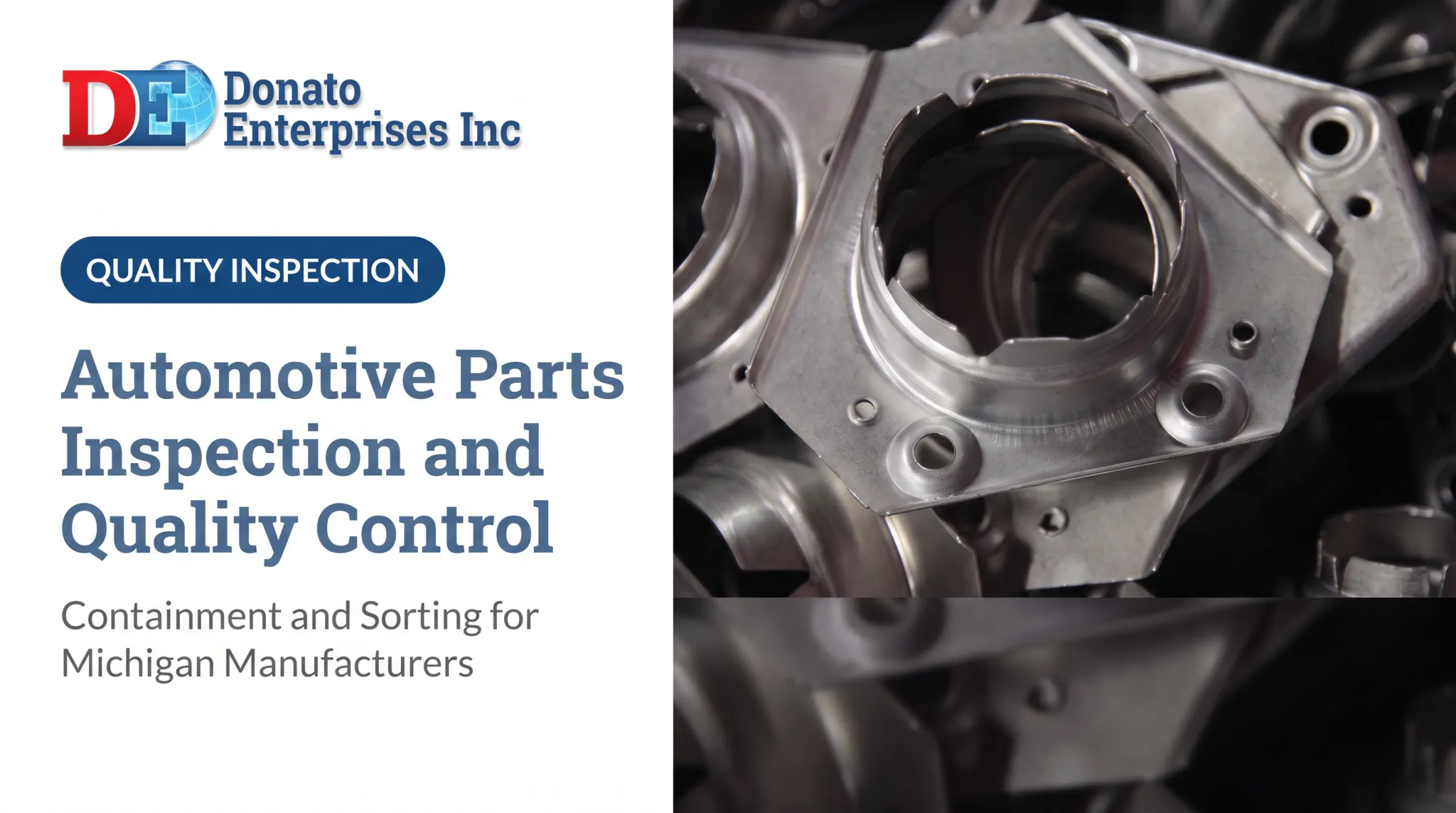
Parts sorting and inspection
A sort can use 100% inspection or another customer-approved plan. Every part is judged against defined good-versus-defective criteria.
Consistency improves with the right controls:
- Defect categories with written definitions
- Sample parts or visual aids
- Gauges and work instructions
- Approved boundary samples
Quality containment for suspect or nonconforming parts
Typical triggers are a customer complaint, a suspect-part alert, CS1/CS2 status, or inventory nobody trusts. Containment keeps questionable material from moving forward while you investigate.
Material should be split into three groups, each identified and traceable:
- Accepted
- Rejected
- Pending disposition
Ford's customer requirements illustrate the mindset: no suspect product ships without sorting or rework, and lot traceability is maintained. Those are Ford-specific controls, so confirm your own customer's rules.

Sorting combined with secondary operations
Sometimes identification is not enough. Sorting can be paired with secondary operations such as:
- Deburring and flash removal
- Cleaning and rework
- Assembly, packaging, and kitting
One coordinated provider means fewer handoffs and fewer places for parts to get mixed. Donato Enterprises offers these services under one roof, though not every service applies to every project.
How a Professional Sorting Process Protects Quality
Establishing the inspection scope
Intake should capture:
- Part numbers and revision levels
- Defect definitions and inspection criteria
- Quantity and urgency
- Packaging requirements
- Customer-specific documentation
Agree on what "acceptable" means before work begins. Cosmetic, dimensional, and application-specific defects are where disputes start.
Controlling and segregating material
Incoming material should be identified, counted, and protected from mixing during inspection, rework, storage, and shipment. The process needs a clear path for:
- Rejected parts
- Reworkable parts
- Approved deviations
- Material awaiting customer disposition
The customer decides disposition; the provider keeps the groups separate and labeled.
Maintaining consistency across the sort
Human inspection varies. One Sandia-published study of 82 inspectors found they rejected 85% of defective items but also wrongly rejected 35% of good parts. It is one specialized setting, not a benchmark for any provider, but the lesson holds.
Reduce variation with:
- Standardized work instructions
- Trained personnel
- Reference samples
- Calibrated tools where required
- An escalation path for ambiguous defects
Documenting results and communicating issues
Useful records include:
- Quantities received, inspected, accepted, rejected, reworked, and held
- Defect categories, dates, and lot information
- Final disposition
Confirm with any provider which reports it supplies. Timely reporting lets you make production, shipment, supplier, and corrective-action decisions faster. Donato Enterprises provides reporting throughout the sorting process.
Supporting corrective action and process improvement
Sorting contains the immediate risk. It does not replace root-cause analysis. ASQ's 8D process treats interim containment, verified root cause, and permanent correction as separate steps.

Sort findings still help. Recurring defect patterns can be shared with production, quality, tooling, molding, stamping, casting, or assembly teams, subject to your quality process.
Manufacturing Situations That Benefit from Sorting Support
Automotive supplier quality spills
Tier 1 and Tier 2 suppliers hit with an OEM complaint or suspect-part alert need people and process quickly. The immediate goal is protecting shipments. Longer-term corrective action and permanent process controls come after, and sorting should not be mistaken for either.
Metal stamping, die casting, and foundry operations
High-volume metal parts can show burrs, dings, dimensional drift, and surface problems. Outsourcing deburring, cleanup, inspection, or rework keeps presses, machining cells, and casting operations running instead of tying up operators.
Plastic injection molding and foam production
Common needs include:
- Flash removal
- Cosmetic sorting
- Component inspection
- Sub-assembly
- Kitting
Moving this work off the molding floor keeps those operations on primary production. Workflows differ by project, so scope each one.
New launches, PPAP, and safe-launch programs
Third-party inspection can give a customer added confidence during safe launch, before normal controls take over. It supplies inspection evidence and containment support. It does not guarantee PPAP approval or production capability.
Outsourced assembly, packaging, and kitting
When floor space or headcount is tight, labor-heavy sub-assembly, repackaging, labeling, and kitting can move off-site. Define requirements up front:
- Assembly steps
- Packaging specs
- Labeling
- Quantity checks
- Final acceptance criteria
What to Expect When Outsourcing Sorting Services
Project intake and quotation
Be ready to share:
- Part details and quantity
- Defect type and inspection standard
- Location of material
- Required completion date
- Packaging and reporting needs
Quotes depend on scope, staffing, inspection complexity, logistics, and any secondary operations. There is no universal price; each engagement is quoted on its own scope.
Planning the work
Before work starts, lock in:
- Material movement and site logistics
- Inspection criteria and segregation methods
- Safety requirements and key contacts
- Escalation rules and approval points
- On-site, off-site, or third-party-site arrangements for that engagement

Completion, reporting, and next steps
At completion, review:
- Final quantities and defect findings
- Rework or disposition status
- Remaining suspect material
- Packaging condition and documentation
Why Work with Donato Enterprises
Experience and manufacturing-support breadth
Donato Enterprises is a family-owned and operated company founded in 1996 by Chris Columbus Donato. It began as a sales enterprise and grew into a full manufacturing-support provider. The team reports more than 100 years of combined experience.
Capabilities now include:
- Inspection, sorting, and quality assurance
- Assembly, packaging, and kitting
- Cleaning and deburring
That breadth helps when sorting must stay coordinated with secondary operations instead of split across vendors. Projects only pull in the services they need.
Proprietary inspection and containment processes
Chris Donato developed the company's proprietary inspection and containment processes, which the company has improved and proven over time. Donato Enterprises reports a sorting effectiveness rate of 99.965%, against an 87% industry standard. That is the company's own figure, not an independently validated industry statistic, so ask how it is measured.
Service values and fit
The company's stated priorities are:
- Defect-free results
- On-time delivery
- Hard work, integrity, and excellence
For quality-critical parts, those are the right standards to test a provider against.
If you manage automotive or other manufacturing parts, contact Donato Enterprises at 810-392-7678 to discuss part requirements, inspection criteria, containment needs, and any rework or assembly services.
Frequently Asked Questions
What are sorting services in manufacturing?
Sorting is the inspection and separation of parts according to agreed acceptance criteria. It contains the problem but is not corrective action or permanent process improvement.
When should a manufacturer use third-party sorting services?
Use them during quality spills, suspect-part alerts, customer complaints, and launches. They also help when labor constraints or inspection volume exceed internal capacity.
What is the difference between sorting and inspection?
Inspection evaluates parts against requirements. Sorting adds the physical separation, identification, and disposition handling needed to control mixed material.
Can sorting services include deburring, cleaning, or rework?
Yes, when those services are in the approved project scope. Sorting can also be combined with assembly, packaging, or kitting.
Can sorting support a customer complaint, quality spill, or safe launch?
Yes. It helps contain suspect material and provides inspection records. It does not replace root-cause analysis, corrective action, or PPAP approval.
How do I request a sorting services quote?
Share the part number, quantity, defect concern, acceptance criteria, material location, deadline, packaging needs, and any reporting or secondary operations. Call 810-392-7678 or use the online form.