
For OEMs, Tier 1 and Tier 2 suppliers, and aftermarket manufacturers, the hard part is the trade-offs: tooling cost, volume, material performance, appearance, tolerances, and what happens when a bad lot ships.
This guide covers the process, materials, applications, trends, and how to evaluate quality support.
Key Takeaways
- Injection molding melts resin, fills a precision mold, cools the part, and ejects it.
- Material choice depends on heat, chemicals, UV, impact, vibration, and appearance.
- Quality depends on inspection, traceability, and containment, not just tooling and settings.
- Early DFM review prevents most sink, warp, and flash problems.
What Is Automotive Plastic Injection Molding?
How the process is defined
Automotive plastic injection molding melts plastic pellets and injects them under pressure into a closed mold. The part cools, solidifies, and is ejected. Autodesk's overview breaks the machine into three parts:
- Injection unit: a hopper and barrel where a reciprocating screw melts and injects the resin
- Clamping unit: holds the mold closed against injection pressure
- Mold: the cavity and core that shape the part, plus cooling and ejection features
Where it is used
The process serves OEMs, Tier 1 and Tier 2 suppliers, and aftermarket makers, across combustion, hybrid, and EV programs. Typical applications include:
- Interiors: door panels, consoles, vents, handles, trim
- Exteriors: bumper fascias, grilles, mirror housings, door handles
- Under the hood and electrical: covers, brackets, connectors, ducts, intake manifolds
Not every grade suits every location. A part near the engine faces very different demands than a dashboard trim piece.
Injection molding versus casting
Casting pours molten metal into a mold. Injection molding shapes plastic. The better choice depends on required material properties, part design, volume, tooling budget, and operating environment.
In general, molding favors lighter parts, complex geometry, and cosmetic surfaces. Casting is usually chosen where metal strength or heat tolerance is non-negotiable. Neither is a universal winner.
How the Automotive Injection Molding Process Works
Part design, DFM, and mold development
Most defects are designed in long before the mold is cut. A DFM review checks CAD models, material specs, draft, wall thickness, ribs, bosses, gates, parting lines, and ejection. Protolabs guidance offers practical rules:
- Keep walls uniform to reduce cosmetic defects
- Use ribs to strengthen tall walls
- Make boss walls 40-60% of the surrounding wall to avoid sink
- Use about one degree of draft per inch of cavity depth, applied consistently
Undercuts, side-actions, and hand-loaded inserts also show up in DFM analysis, and each adds tooling cost.
The five process stages
- Prepare the resin: dry it when the material requires it.
- Melt and plasticize: the screw heats and homogenizes the pellets.
- Clamp, inject, pack, and hold: the cavity fills and packing compensates for shrinkage.
- Cool: the part solidifies to ejection temperature.
- Open, eject, trim, and inspect: remove the part and check it against spec.

Terminology varies by machine, resin, and supplier. Each stage still affects accuracy, appearance, and cycle time.
Advanced molding techniques
Overmolding, insert molding, and structural foam solve specific problems. Examples from ENGEL's automotive brochure include:
- Multi-component molding on pillar trim, integrating mounting, optical, and sealing elements in one step
- Structural foam plus a sealing lip on climate-control vents
- Film insert molding for control panels with integrated switching foils
- Insert-molded sheets overmolded with plastic for reinforcement
These are manufacturer examples. Validate any technique against your own part and requirements.
Process controls and defect prevention
Resin moisture, melt temperature, injection pressure, mold temperature, cooling time, and clamp force all drive defects.
| Defect | Common cause | Typical fix |
|---|---|---|
| Sink marks | Thick sections, low packing pressure | Thinner ribs, higher packing |
| Warpage | Uneven walls, unbalanced cooling | Uniform walls, balanced cooling |
| Flash | Low clamp force, high injection pressure | Check tonnage, reduce pressure |
| Short shots | Cold melt, low pressure, trapped air | Raise melt temperature, add vents |
| Weld lines | Flow fronts meeting | Move gate, speed up injection |
Source for the defect table: Texas Injection Molding. Process validation, first-article inspection, material traceability, and documented corrective action keep these problems from reaching the customer.

Tooling economics and production volume
Molds are a large upfront investment. Several factors drive program cost:
- Cavity count and part size
- Complexity, steel grade or aluminum, and surface finish
- Tool life, maintenance, and automation
Volume spreads that cost: two identical molds can double output, as ENGEL notes.
Prototype, bridge, and launch programs often need different tooling strategies than full production. Get tooling quotes for your specific part rather than relying on generic price ranges.
Materials and Applications in Automotive Injection Molding
Common plastics and selection criteria
Common families include polypropylene, ABS, polycarbonate, nylon (polyamide), PVC, PMMA, TPE, TPU, and reinforced engineering plastics. Grade and additives matter as much as the family.
Engineers weigh:
- Heat resistance and impact strength
- Stiffness and fatigue
- Chemical and UV exposure
- Flame performance and dimensional stability
- Appearance, recyclability, and compatibility with adjacent materials
Supplier examples show how specific this gets. SABIC lists PP copolymer grades for door panels, pillar cladding, and bumper fascias, with inherent low gloss and scratch resistance.
BASF positions glass-reinforced Ultramid polyamides for air intake manifolds and oil pans, and Ultradur PBT for mirror bases and LED module frames. These are supplier examples, not interchangeable specs.
Plastics used for car trim
Trim may use polypropylene, ABS or PC/ABS blends, TPE or TPU, and nylon. Confirm each material-to-component pairing with the resin supplier's technical data.
Trim designers balance:
- Scratch and mar resistance
- UV stability and texture retention
- Color consistency and soft-touch feel
- Dimensional accuracy and fit with clips or adjacent parts
Appearance, surface finish, and part consolidation
Visible surfaces are shaped by mold polish, texture, grain, draft, parting-line placement, and gate location. Process stability matters too: drift shows up as gloss or color variation.
Part consolidation can cut hardware and assembly steps when the design is validated. Common methods include overmolding, insert molding, snap-fits, ribs, and bosses.
Sustainability and recycled materials
Main levers include lightweighting, efficient runners, regrind, recycled resin, bio-based materials, and design for disassembly. The trade-offs are real:
- ABS is melt-incompatible with most thermoplastics, including polyolefins and polyamides, so mixed streams risk delamination and weak parts
- Recycled-resin property data depend on mold design, processing, and coloring; supplier figures are guide values only
- Recycled content typically needs customer approval
Benefits, Challenges, and Industry Outlook
Scalability and repeatability
Once tooling and parameters are qualified, molding supports automated, repeatable production. Cycle time, cavity count, labor, scrap, and machine utilization determine economics. Robots, sensors, and process monitoring cut manual variation. ENGEL describes weight and flow control systems that stabilize processes and document settings.
Automotive programs often add documented tolerances, inspection plans, capability studies, and formal corrective action.
Lightweighting and design freedom
Engineered plastics can replace selected metal parts, consolidate components, and enable complex shapes. The Department of Energy says a 10% vehicle-weight reduction can improve fuel economy 6-8%. In hybrids and EVs, lighter materials can offset battery and motor mass.

That is a vehicle-level relationship, not a guarantee for any one part. Plastic is not an automatic substitute for metal in structural, safety-critical, high-temperature, or high-load applications.
Common challenges
- Long tooling lead time and high mold cost
- Shrinkage, warpage, flash, sink, and weld lines
- Color variation and dimensional drift
- Tool wear
- Design limits such as deep undercuts and uneven walls
Design reviews, mold-flow analysis, proper drying, preventive maintenance, and inspection reduce the risk.
Industry trends
EV programs, lightweighting, recycled and bio-based polymers, process monitoring, and automation are shaping demand. One research-firm estimate puts the global automotive injection-molding segment at $18.5 billion in 2025, with a forecast of $30.4 billion by 2033. Treat that as a forecast, not realized growth.

Quality Assurance and Choosing the Right Manufacturing Partner
Supplier evaluation criteria
Use a checklist when qualifying a molder or support provider:
- Automotive program experience
- Material and tooling capability
- Fit with your production volume
- DFM support
- Process validation and inspection equipment
- Traceability and documentation
- Maintenance practices
- Ability to manage launches and engineering changes
Verify IATF 16949 or ISO certification directly against the supplier's current certificate. Customer-specific requirements also vary. GM's, for example, include notifying the certification body within 5 business days of Controlled Shipping Level 2 status. Those rules apply to GM supply, not every molder.
Post-molding inspection and manufacturing support
When labor, floor space, or capacity is limited, molders often outsource secondary work:
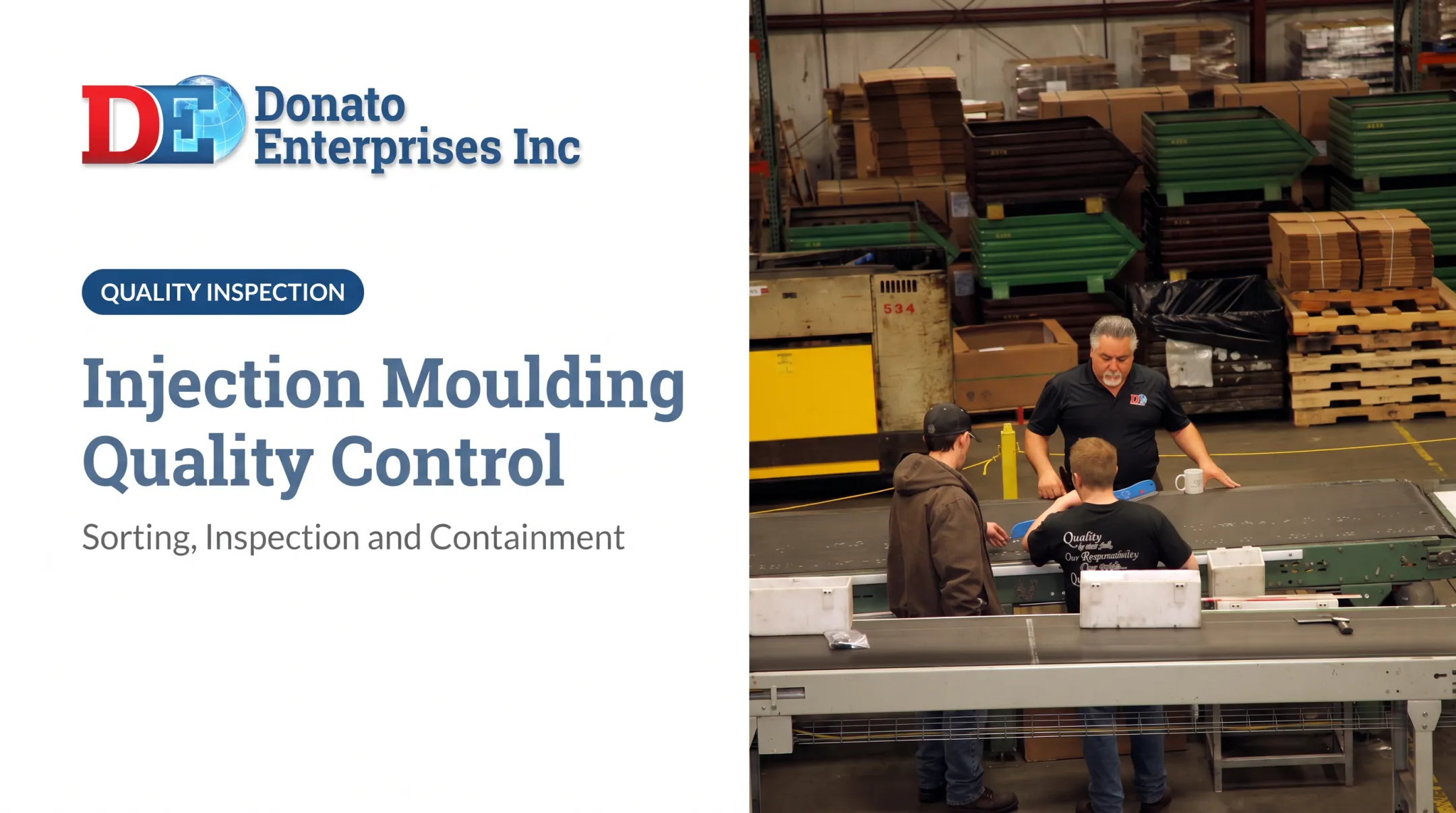
- 100% inspection and sorting
- Flash removal, deburring, and cleaning
- Rework, sub-assembly, packaging, and kitting
This support matters most during quality spills, customer complaints, safe-launch programs, and PPAP efforts. The goal is to protect shipments and keep lines running.
Donato Enterprises as a support resource
Donato Enterprises, Inc. is a family-owned manufacturing-support company in Memphis, Michigan, founded in 1996. It does not mold parts. It handles what comes after: inspection, sorting, quality containment, assembly, packaging, cleaning, deburring, kitting, and parts rework.
Relevant details for molders and automotive suppliers:
- Proprietary inspection and containment processes
- PPAP and GP-12 inspection, plus safe-launch support, on-site or at its facility
- Dimensional checks with calipers and gages, and attribute inspection for cosmetic defects
- Flash removal, cosmetic sorting, sub-assembly, and kitting kept off the molding floor
- Over 100 years of combined team experience
- A reported sort accuracy of 99.965%

The company serves Eastern and Central Michigan, including Grand Rapids and Branch County. Its work applies QSB and ISO guidelines; confirm credentials directly when qualifying any provider.
Frequently Asked Questions
How much do injection molded parts cost?
Cost depends on resin, part size, geometry, tolerances, cosmetics, tooling, cavity count, volume, cycle time, labor, inspection, and secondary operations. A project-specific quote is the only reliable answer.
How much does a mold for plastic injection cost?
It varies with complexity, steel or aluminum, cavity count, surface finish, tool life, cooling design, and automation. Request quotes against your part drawings.
What are the 5 steps of injection molding?
Resin preparation, melting and plasticizing, injection and packing, cooling, then mold opening, ejection, trimming, and inspection.
What is automotive molding?
It is the use of molding processes to make vehicle components. Injection molding is a major method, alongside compression, blow, rotational, and thermoforming processes.
What type of plastic is used in automotive?
Common choices include polypropylene, ABS, polycarbonate, nylon, PVC, PMMA, TPE, TPU, and reinforced engineering plastics. Heat, impact, chemical, UV, dimensional, and appearance needs set the grade.
What plastic is used for car trim?
Trim often uses polypropylene, ABS or PC/ABS, TPE, TPU, or nylon. Location, texture, scratch resistance, UV exposure, flexibility, and attachment method decide the final choice.