Global corrosion costs alone are estimated at $2.5 trillion, about 3.4% of global GDP. Surface condition matters. This guide covers burrs, contamination, coating failure, dimensional drift, quality complaints, and press-floor bottlenecks. It also explains how processing differs from finishing, the main stages, common finishing options, and when outsourcing secondary operations makes sense.
Key Takeaways
- Processing shapes the metal; finishing changes the surface or performance.
- Material, geometry, volume, tolerances, and service environment should drive process choice.
- Deburring, cleaning, inspection, and packaging decide whether parts are ready to ship.
- Pick coatings by corrosion, wear, conductivity, appearance, and dimensional limits.
What Is Industrial Metal Processing and Finishing?
What industrial metal processing means
Industrial metal processing turns raw metal into specified shapes and functional components.
Britannica's definition describes materials processing as a series of operations that transform industrial materials into finished parts. In metalwork, that includes cutting, forming, rolling, stamping, machining, bending, joining, and casting.
Primary operations create the basic form. Secondary operations refine, inspect, clean, or prepare the part for use.
How processing differs from finishing
Processing changes shape, dimensions, or structure. Finishing changes the surface condition: appearance, cleanliness, hardness, corrosion resistance, or friction.
Take a stamped steel bracket. It is cut and formed during processing. Then it is deburred, cleaned, coated, inspected, and packaged.
Materials and why finishing matters
Ferrous metals (carbon steel, alloy steel, stainless steel) and nonferrous metals (aluminum, copper, brass, zinc) behave differently. Strength, weight, conductivity, corrosion behavior, and hardness all affect which cutting, deburring, cleaning, heat treatment, and coating methods work.
Aluminum, for example, calls for different media and chemistry than carbon steel.
Finishing is not cosmetic alone. It affects:
- Corrosion and wear resistance
- Safe handling
- Paint and coating adhesion
- Clean assembly
- Customer acceptance and service life
The Main Stages of Industrial Metal Processing
Material preparation and primary shaping
Production starts with material selection and incoming verification. Primary shaping follows: cutting, blanking, slitting, rolling, casting, forging, stamping, bending, or machining.
Typical equipment includes presses, rolling mills, slitting lines, cut-to-length lines, tube mills, levelers, and machining centers. No single facility runs all of them.
Secondary operations and edge conditioning
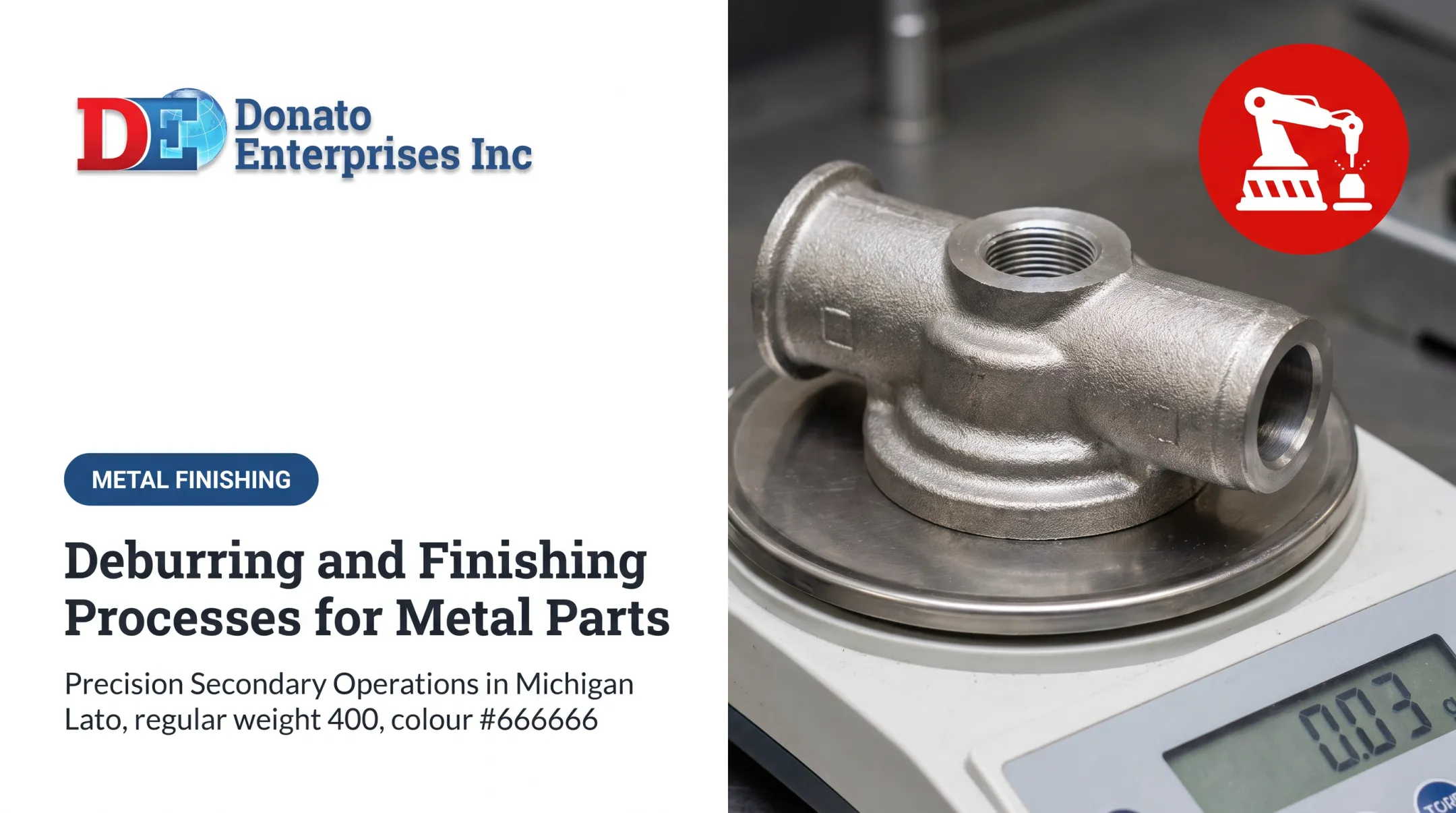
Forming and machining leave burrs, flash, and sharp edges. Deburring, edge breaking, trimming, grinding, polishing, and rework remove them before they interfere with assembly, handling, or coating.
Edge requirements belong on the drawing. ISO 13715 covers indicating and dimensioning undefined edges, though it sets no universal burr-height limit. Agree on a limit with the customer.
Cleaning and surface preparation
Oils, scale, oxides, chips, and residue usually need to come off before coating, plating, painting, or inspection. Common preparation includes degreasing, washing, abrasive blasting, chemical cleaning, and passivation. Verify technical and safety requirements for each process and substrate.
Inspection, sorting, and containment
Inspection can be visual, dimensional, functional, or surface-based. Depending on risk and customer expectations, plants use:
- First-piece inspection to validate the setup
- Sampling tied to risk and volume
- 100% inspection on critical characteristics
- Defect sorting with full traceability
- Temporary containment during quality spills
GM's March 2025 requirements allow final inspection at 100% or less based on risk. Check your own customer's current rules.
Final protection and shipment readiness
Drying, corrosion prevention, labeling, packaging, kitting, and documentation preserve quality between the last process and assembly. Feedback from final inspection and rejected parts should go back upstream so the same defect doesn't recur.

Common Industrial Metal Finishing Methods and Coatings
Mechanical finishing
- Deburring and grinding: remove burrs and shavings from edges and seams
- Tumbling and vibratory finishing: smooth and clean batches of small parts
- Abrasive blasting: removes scale and prepares surfaces
- Brushing and buffing: blends and polishes
- Shot peening: improves fatigue performance
Media, pressure, cycle time, geometry, and hardness must be controlled. Otherwise you damage edges, dimensions, or cosmetic surfaces.
Chemical and electrochemical treatments
- Electroplating and electroless plating: corrosion resistance, conductivity, wear
- Anodizing: aluminum corrosion and wear resistance, controlled appearance
- Passivation: restores stainless corrosion resistance
- Electropolishing: reduces roughness and improves cleanliness
- Conversion treatments: improve paint adhesion
Organic, thermal, and conversion coatings
Powder coating, liquid paint, black oxide, thermal spray, and phosphate coatings each suit different substrates and performance needs.
Thickness, curing conditions, adhesion, masking, coverage, and dimensional buildup all affect the result. Plating and coating systems are assessed separately: GM's requirements list CQI-11 for plating and CQI-12 for coating.

How metallic coatings differ
A metallic coating is a layer of another metal or alloy on a substrate. Electroplated and electroless coatings are deposited chemically or electrically, while clad coatings are bonded layers.
Choose based on:
- Base metal and corrosion environment
- Electrical or thermal needs
- Wear, solderability, and appearance
- Cost and allowable dimensional change
Environmental, safety, and compliance considerations
Cleaning, plating, conversion, and painting can involve chemicals, emissions, regulated waste, and wastewater. Applicable rules include:
- EPA 40 CFR Part 433: metal finishing wastewater standards for covered operations
- OSHA 1910.1026: hexavalent chromium limit of 5 µg/m³ as an 8-hour average
- OSHA 1910.94: abrasive blasting ventilation and respirator requirements
Applicability depends on the operation. Confirm current federal, state, and customer requirements rather than assuming one method fits everything.
Choosing the Right Process and Controlling Quality
Match the process to the part
Evaluate before committing:
- Substrate, thickness, and geometry
- Tolerances and edge conditions
- Production volume and cycle time
- Downstream assembly
- Service environment
A process that suits small, high-volume stampings may wreck a large, delicate, or dimensionally sensitive component.
Balance performance, cost, and lead time
Compare the performance gain against tooling, labor, material, energy, inspection, rework, packaging, environmental, and turnaround costs. Where appearance, adhesion, burr limits, or corrosion performance is critical, run a sample trial first.

Establish measurable controls
Document these before production starts:
- Dimensions and allowable burr height
- Surface condition and cleanliness
- Coating type, thickness, and appearance
- Defect limits and inspection frequency
- Packaging and traceability
When qualifying a supplier, ask about equipment, process controls, inspection capability, corrective-action procedures, containment response, and documentation. Customers set their own expectations: Stellantis requires 8D reports for containment and corrective action, for example.
When Outsourcing Secondary Operations Makes Sense
Situations that justify outsourcing
- Customer complaints or suspect-part alerts
- CS1 or CS2 containment
- Safe-launch programs and new-part launches
- Labor shortages
- High-volume sorting
- Press-floor bottlenecks
- No specialized deburring or cleaning capacity
Outsourcing lets presses, casting cells, molding, machining, and assembly keep running.
Services manufacturers outsource
Typical services include:
- 100% inspection and sorting
- Deburring, flash removal, and cleaning
- Rework, assembly, and kitting
- Repackaging, labeling, and shipment preparation
Before work begins, give the provider:
- Defect criteria, drawings, or work instructions
- Sample parts and acceptance standards
- Lot information and escalation contacts
Donato Enterprises as a manufacturing-support resource
Donato Enterprises, Inc. is a family-owned manufacturing-support company founded in 1996 and based in Memphis, Michigan. It handles inspection, sorting, quality containment, cleaning, deburring, parts rework, assembly, packaging, and kitting. Its team brings over 100 years of combined experience.
Proprietary inspection and containment processes serve automotive suppliers and other manufacturers needing defect control. The company reports a 99.965% sorting effectiveness rate, against an industry standard of 87%. Donato does not offer plating or primary metal forming.

Considering outsourced support? Be ready to discuss part type, defect or finishing requirements, volume, timing, inspection criteria, and packaging needs. Call 810-392-7678 for a custom quote.
Frequently Asked Questions
What does industrial metal processing mean?
It is the shaping, cutting, forming, machining, joining, casting, or other transformation of metal into specified parts or products.
What are the most common types of metals used in industry?
Steel, stainless steel, aluminum, copper, brass, and zinc. The best choice depends on strength, weight, conductivity, corrosion resistance, and the application.
What does industrial metal supply do?
A supplier sources, stocks, cuts, and delivers metal material. A processor or finisher transforms or treats that material.
What are the different types of metallic coatings?
Electroplated, electroless, and clad coatings are the main categories. The right one depends on corrosion, wear, conductivity, appearance, substrate, and dimensional limits.
How do I choose the right metal finishing process?
Compare substrate, geometry, service environment, performance goals, volume, tolerances, budget, lead time, and customer or regulatory requirements.
When should a manufacturer outsource metal deburring or sorting?
During quality spills, safe launches, production surges, or labor shortages, and when internal equipment or staff can't deliver the needed timing or consistency.