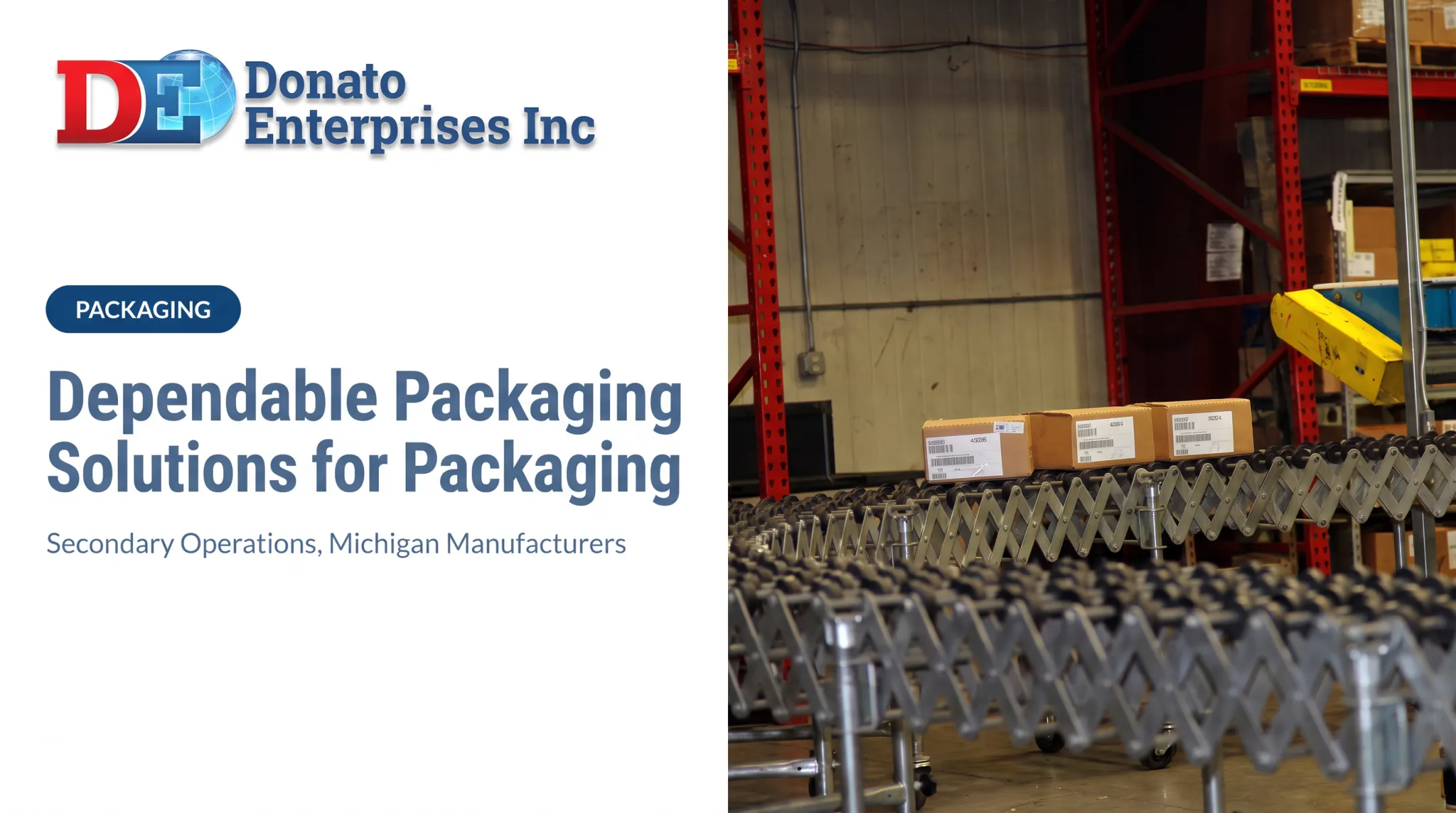
These failures usually start in a weak packaging process, not on the production line.
Packaging operations are the activities that inspect, pack, label, document, and release finished goods. Packaging manufacturing is the production of the boxes, trays, totes, inserts, films, and labels those operations use. This guide covers both, with a focus on US manufacturing and industrial parts.
Key Takeaways
- Packaging operations cover inspection, preparation, packing, labeling, documentation, and release.
- Manufacturing builds the containers; operations use them to protect finished goods.
- Effective packaging contains, protects, preserves, eases handling, and communicates.
- Quality controls and outside support help when capacity, labor, or containment runs short.
What Are Packaging Operations?
Packaging operations are the coordinated steps that move a part from inspection into a correctly identified, protected, shipment-ready package.
The Five Functions of Packaging
ISO terminology defines packaging as a product or operation covering containment, protection, handling, and presentation. Manufacturing teams typically work with five practical functions. These expand on the ISO framing rather than restating a mandated ISO list:
- Contain the product
- Protect it from damage or contamination
- Preserve its required condition
- Make handling and transport efficient
- Communicate through labels, markings, and traceability data
Packaging vs. Packing
Packing is the physical act of placing products and materials into a container. Packaging is the larger system: selecting materials, preparing and protecting parts, identifying them, and presenting the finished unit. Operators pack. The process owner designs the packaging.
Packaging Procedure: A Typical Operational Sequence
Details vary by customer, but most procedures follow this order:
- Review the specification. Read the customer requirements and work instructions. Confirm the approved container, dunnage, and label format.
- Stage the work area. Bring parts, containers, labels, and protective materials to the station.
- Verify the parts. Check identity, quantity, orientation, cleanliness, and condition before anything goes in a container.
- Pack and protect. Add dividers, wraps, cushioning, or corrosion protection when the part design or handling environment calls for it.
- Label and document. Apply barcode or lot identification and complete the packaging records.
- Palletize and release. Build the unit load, stage it, and release it for storage or shipment.

Customer-specific requirements drive label content. AIAG's B-10 guideline provides shipping-label templates for trading partners, so confirm which edition your customer expects.
What Does a Packaging Operator Do?
Operators follow the work instruction, set up the station, pick the correct container, count parts, and check for visible defects. They apply labels and record the required information.
Equally important, they stop bad product. Damaged, suspect, mislabeled, or nonconforming parts get escalated rather than slipped into a shipment.
Training should cover:
- Safe lifting and handling
- Packaging specifications and traceability
- Equipment use and housekeeping
- Quality escalation procedures
On lifting, OSHA sets no single general weight limit. NIOSH's 51-pound figure is only the starting input to an equation that adjusts for frequency, height, reach, and twisting. Evaluate the actual lift.
Packaging Manufacturing Process: From Design to Finished Packaging
Packaging manufacturing produces the box, tray, tote, insert, film, label, or pallet configuration. The exact process depends on the material and the package design.
Design, Specifications, and Prototyping
Engineers translate part dimensions, weight, fragility, stacking needs, handling conditions, and customer requirements into a package specification. Sustainability goals enter here too.
Drawings, CAD models, sample builds, and trial runs confirm fit, access, and protection. ASTM D6198 is a guide for transport packaging design that weighs distribution hazards against material, labor, and transport costs.
Material Selection
No material suits every application. Common choices include:
- Corrugated fiberboard and paperboard
- Plastic containers and reusable totes
- Foam and protective inserts
- Films and VCI corrosion-protection materials
- Wood pallets and metal racks
Selection affects strength, moisture and corrosion protection, part visibility, storage density, cost, and waste. Returnable containers are not automatically better. Automotive packaging guidance says the decision depends on return-route costs, repacking, damage, trailer cube, and volume variation. Many foams are also hard to recycle.
Printing, Marking, and Identification
Packages may carry part numbers, revision levels, lot codes, barcodes, handling instructions, and customer-specific marks. Which rules apply depends on the shipment:
- Hazardous materials fall under 49 CFR Parts 172 and 173, but only when the shipped material is regulated.
- ISPM-15 treatment marks apply to covered wood packaging in certain international routes, not every domestic pallet.
- "Made in USA" claims must meet the FTC's "all or virtually all" standard, and only matter if you make the claim.
- GS1 logistic labels and AIAG labels apply where customers require them.
Determine the governing requirement before printing.
Converting, Forming, and Finishing
Production steps include cutting, scoring, folding, molding, heat forming, sealing, gluing, welding, stitching, and assembling. Corrugated, for example, is made from linerboard and fluted medium, then printed, die-cut, folded, and glued or stitched.

The right process depends on whether the package is disposable or reusable, rigid or flexible, and whether it must run on an automated line.
Testing and Integration
Test only what the product risk justifies. Options include fit and dimensional checks, closure checks, and distribution testing:
| Test | Purpose |
|---|---|
| ISTA 1A | Integrity test for packaged products up to 150 lb |
| ISTA 3A | Simulates parcel-distribution hazards |
| ASTM D642 | Compression of containers and unit loads |
| ASTM D5276 | Free-fall drop of loaded containers |
| ASTM D999 | Vibration of filled shipping containers |

Define the distribution environment and acceptance criteria first, then pick the test. After approval, packaging is delivered to the floor, stored, replenished, and integrated into the packing line.
Quality Control and Process Improvement
Controls at Each Stage
- Incoming: check packaging specification, dimensions, cleanliness, damage, quantity, labeling, and revision status.
- In-process and final: verify part identity, quantity, orientation, protection, container condition, label accuracy, pallet configuration, and documentation.
- Nonconformance: isolate suspect product, identify affected lots or shipments, document findings, notify the customer or internal quality team, and release only verified material.

NIST supplier guidance points to rejection handling and lot control as the way to identify affected production groups.
Measures Worth Tracking
Track packaging KPIs that matter to shipment quality:
- Packaging defects and transit damage
- Mislabeling and rework volume
- Material waste and changeover time
- Late shipments and customer complaints
Agree on definitions and targets with your customer. No authoritative cross-industry numeric benchmark exists, so set your own.
Continuous Improvement and Automation
Once validated, these controls reduce variation:
- Standardized work instructions and visual aids
- Barcode scanning and weight-count scales
- Fixtures and automated labeling
- Vision inspection, where lighting, contrast, and optics determine whether the system works
Automation supports a controlled process. It does not replace specification review, operator training, or defect escalation.
When Should Manufacturers Outsource Packaging Operations?
Outsource packaging when demand, quality events, or capacity limits outpace what your floor and headcount can absorb without slowing primary production.
Common triggers include:
- Sudden volume increases
- Launch or safe-launch programs
- Customer complaints or suspect-part alerts
- Labor shortages
- Limited floor space
- Specialized rework
- Keeping core equipment running
Labor pressure is part of the backdrop. A Deloitte and Manufacturing Institute study forecasts about 1.9 million unfilled jobs over 2024–2033. That is a manufacturing-wide figure, not a packaging benchmark.
Examples by Industry
- Tier 1 and Tier 2 automotive suppliers: containment after a suspect-part alert or CS1/CS2 status.
- Metal stampers: sorting and deburring so presses keep running.
- Plastic molders: flash removal and cosmetic sorting off the molding floor.
- Die casters and foundries: labor-intensive cleanup of raw castings.
- Component makers and distributors: off-site assembly, kitting, and repackaging.
Benefits and Risks of External Support
Benefits of external support include:
- Flexible labor when volume spikes
- Faster response to quality issues and launch needs
- Dedicated inspection resources off your floor
- Less disruption to primary production
- Packaging, assembly, sorting, cleaning, and deburring under one provider
Risks to manage include:
- Unclear specifications
- Weak traceability
- Inconsistent packaging materials
- Transportation delays
- Communication gaps
Reduce those risks before work moves:
- Written work instructions and acceptance criteria
- Label and revision control
- Regular reporting
- Named escalation contacts
- A defined release procedure
How to Evaluate a Packaging Support Partner
Use this checklist:
- Experience with your type of parts and volumes
- Inspection and containment methods
- Documentation and lot traceability
- Turnaround time and material sourcing
- Quality controls and safety practices
- Clear communication
Then validate with a short trial:
- Run a controlled trial on real parts
- Inspect samples against your specs
- Get documented packaging approval
- Review how the provider handles defects and releases shipments

Where Donato Enterprises, Inc. Fits
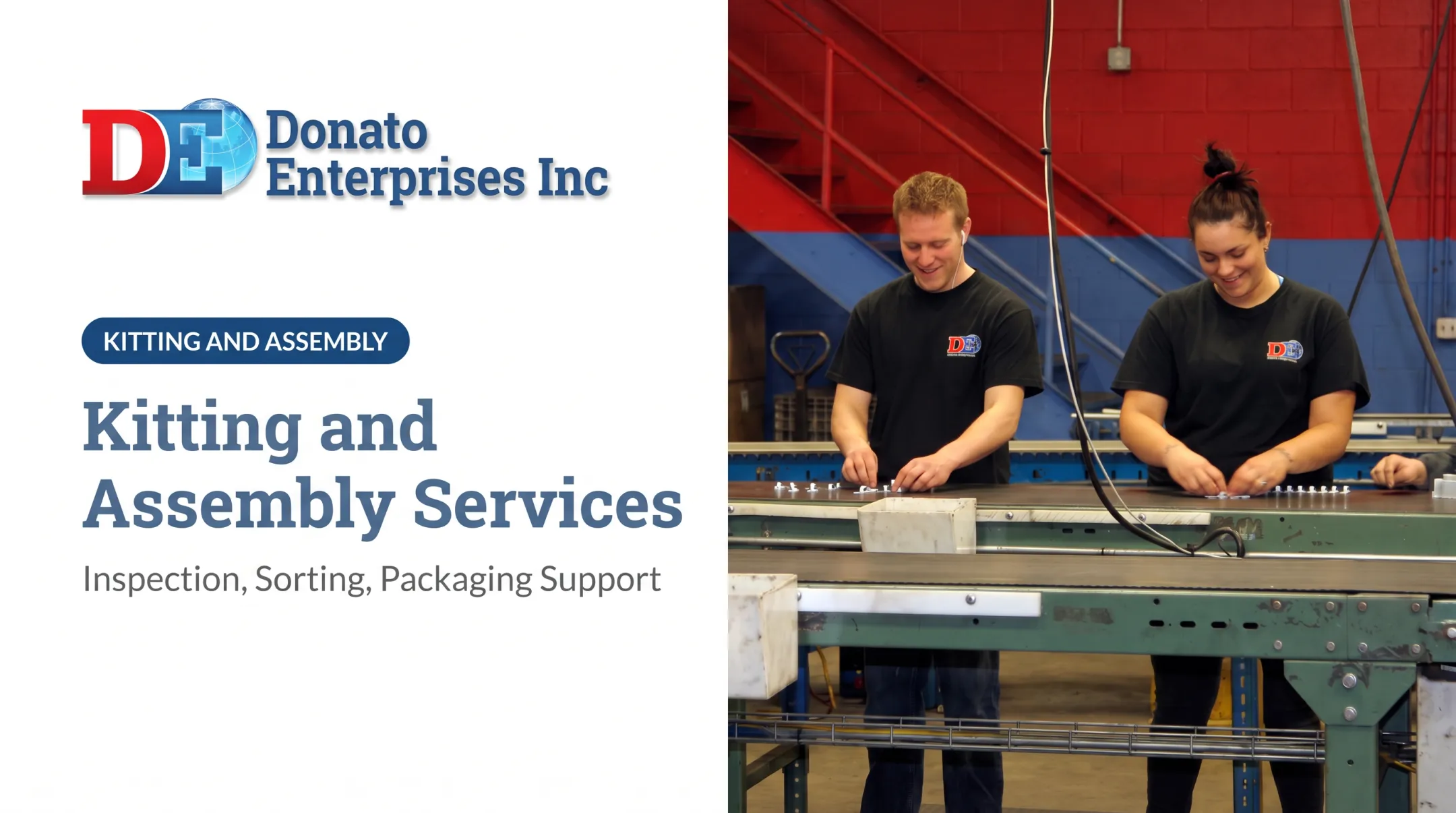
Donato Enterprises, Inc. is a family-owned manufacturing-support provider established in 1996 and based in Memphis, Michigan. Its services include inspection, sorting, assembly, packaging, cleaning, deburring, kitting, rework, and quality containment.
On the packaging side, the team:
- Verifies labels against the part and package
- Confirms each new package holds the quantity outlined in PPAP
- Uses barcode scanners and Plex ERP experience
- Handles parts from 0.01 kg to several tons
- Repacks bulk product into smaller containers for assembly plants
A single partner fits best when packaging is tied to a quality spill, customer complaint, production launch, rework, or labor-heavy secondary operation. If you have a project in mind, contact Donato Enterprises to discuss your requirements and request a quote.
Conclusion: Building a More Reliable Packaging Process
Packaging is a manufacturing control point, not just the last step before the dock. It affects protection, traceability, handling, quality, and on-time delivery.
Build reliability with a clear sequence:
- Define packaging specifications up front
- Select materials that match the part and route
- Standardize the procedure and train operators
- Verify every shipment and measure results
- Outsource specialized or capacity-constrained work when it makes sense
Frequently Asked Questions
What is the packaging procedure?
Review the specification, verify materials and parts, pack and protect, label, and complete documentation. Then perform a final inspection and release the shipment.
What does a packaging operator do?
Operators prepare the station, check parts and quantities, and pack per instructions. They label containers, record required information, and escalate defects.
What are the 5 main functions of packaging?
Containment, protection, preservation, efficient handling and transport, and communication or identification. This is a practical summary rather than a single standard's list.
What are five types of packaging?
Commonly cited categories are primary, secondary, tertiary, protective, and reusable or returnable packaging. Classifications vary by industry; ISO recognizes three levels: primary, secondary, and transport.
Why is packaging important in manufacturing?
It protects products, prevents mix-ups and damage, and supports traceability. It also enables efficient handling and helps meet customer and shipping requirements.
When should a manufacturer outsource packaging operations?
Common triggers are capacity surges, labor constraints, launches, and quality containment. Rework, assembly, kitting, and limited floor space are others.