This guide defines metal finishing, groups the major process families, compares common techniques, and explains how to select and verify a finish. It also covers quality checks, safety, and where secondary operations fit.
Key Takeaways
- Metal finishing spans mechanical, chemical, electrochemical, coating, and specialty treatments, not one process.
- Base metal, geometry, environment, appearance, tolerance, volume, and budget drive the choice.
- Coordinate finishing with cleaning, deburring, inspection, rework, and packaging.
- Put the finish requirements in the purchase order and approve samples first.
What Metal Finishing Does
Metal finishing is a group of post-fabrication or post-machining processes that modify, clean, smooth, protect, harden, color, or otherwise improve a metal surface. The NASF lists these among the main functions:
- Corrosion and wear resistance
- Lubricity and dimensional change
- Electrical conductivity or insulation
- Solderability and thermal management
Two broad families exist:
- Material-removal processes reshape or smooth the surface (grinding, polishing, blasting, deburring).
- Surface-treatment processes create or apply a protective or functional layer (plating, anodizing, coating).
Why finishing matters in manufacturing
Finish requirements tie directly to outcomes:
- Part fit and customer specifications
- Durability in humid or chemical environments
- Safe handling and lower risk of early failure
A good-looking finish is not automatically a protective one. A polished surface may need a coating to survive outdoors, and a rugged coating may fail a cosmetic spec. Match the finish to the component's intended use.
Be careful with service-life claims, too. Salt-spray testing under ASTM B117 gives relative corrosion-resistance information, and the standard does not convert hours into field life.
Types of Metal Finishing Processes
Finishing often runs as a sequence. Cleaning and deburring come before a plating or coating step, and skipping them shows up as adhesion problems later.
Mechanical finishing
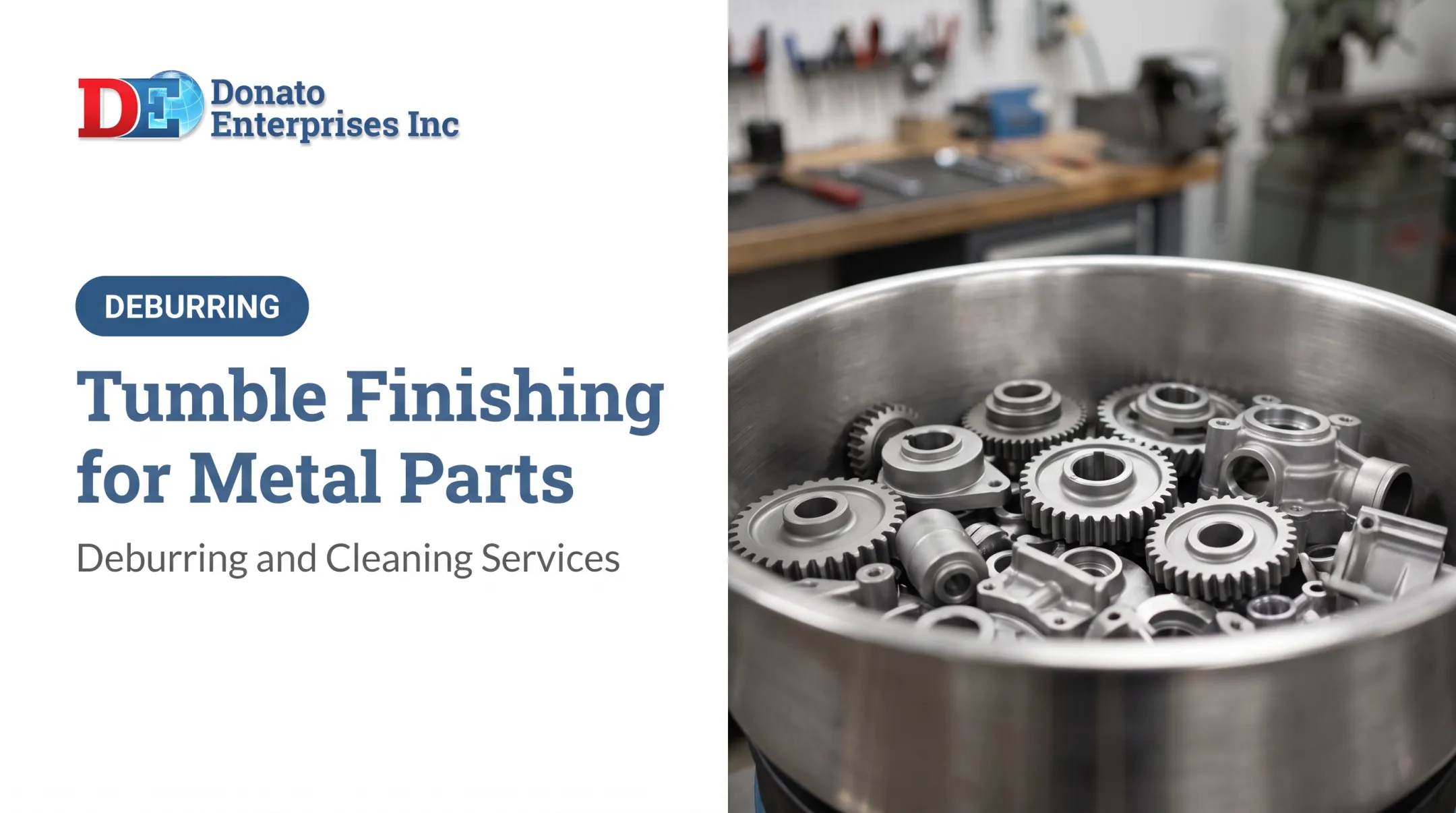
Grinding, sanding, brushing, polishing, buffing, lapping, abrasive blasting, tumbling, and vibratory finishing physically remove material, smooth irregularities, texture the surface, or eliminate burrs.
Typical outputs:
- Dimensional refinement and edge conditioning
- Matte or brushed textures
- Reduced roughness
- Reflective surfaces
Chemical and conversion treatments
Passivation, phosphating, black oxide, and pickling use controlled reactions to clean the surface or form a conversion layer, without a thick external coating. Purposes differ:
- Passivation restores stainless steel's protective surface.
- Phosphating improves paint adhesion on ferrous metals.
- Black oxide offers limited protection in mild conditions, per MIL-DTL-13924.
- Pickling removes scale and oxides.
Electrochemical and plating processes
Electroplating deposits metal using current. Electroless plating deposits metal chemically through a reducing agent and can give uniform deposits. Anodizing converts aluminum's surface into oxide. Electropolishing selectively removes surface irregularities.
Current distribution, substrate conductivity, geometry, and bath control all affect uniformity. Don't assume identical coverage on every shape.
Applied coatings
Powder coating and liquid paint form barrier layers that add color, corrosion resistance, chemical resistance, or wear protection. The tradeoffs are thickness, cure temperature, masking, edge coverage, adhesion, and the effect on close-fitting parts.
Thermal and specialty treatments
Hot-dip galvanizing, thermal spray, shot peening, and laser treatments serve heavy corrosion exposure, high temperatures, fatigue performance, or repair. They are engineered solutions, not cosmetic substitutes.

Common Metal Finishing Techniques: Uses and Tradeoffs
For each technique, ask what it accomplishes, which parts it suits, and what limits apply before production.
Grinding, deburring, and abrasive finishing
Grinding removes material and corrects surface irregularities. Deburring removes sharp edges and leftovers from stamping, machining, casting, or cutting. Choose among manual, vibratory, tumbling, and blasting based on size, geometry, volume, consistency, and fragile features.
Dimensions matter here. SME reports 124 deburring processes, and only two leave dimensions unchanged. One micro-assembly example involved a 0.020-inch part that couldn't tolerate an edge break over 0.001 inch. Inspect critical features after processing.
Polishing, buffing, and brushing
Polishing refines the surface progressively with finer grits. Buffing is a final gloss step and removes no meaningful metal. Brushing creates a controlled directional or matte texture.
These methods improve appearance and smoothness but are labor-intensive, hard to apply in recesses, and no substitute for a needed protective coating. Satin finishes suit handled surfaces, mirror finishes suit customer-facing or easy-clean parts.
Anodizing, passivation, and chemical conversion
Anodizing builds an integral oxide layer on aluminum. Passivation improves stainless steel by removing surface contamination, per ASTM A967 or SAE AMS2700. They are not interchangeable.
Anodizing adds thickness. The Aluminum Anodizers Council gives Type II at 1.8-25.4 µm and Type III hard coat at 12.7-115 µm, and MIL-PRF-8625 says each surface grows by roughly half the coating thickness. Show both machined and coated dimensions on the drawing.
Bath control, rinsing, waste handling, and material specification should be verified with a qualified provider.
Electroplating and electroless plating
Electroplating can deposit precisely on suitable geometries. Electroless plating relies on chemistry and tends to cover complex shapes more evenly. Goals include corrosion protection, conductivity, hardness, wear resistance, solderability, and decoration.
Specify the right standard. ASTM B633 covers zinc on steel with four thickness classes, and ASTM B733 covers electroless nickel-phosphorus (B488 is gold). Define substrate prep, masking, thickness, adhesion testing, and recess coverage. For high-strength steels, address hydrogen embrittlement through ASTM B850 baking and pretreatment controls.

Powder coating, painting, and galvanizing
Powder and paint give colored or protective barriers. Galvanizing (ASTM A123) applies zinc to steel for demanding corrosion environments.
| Factor | Powder/paint | Galvanizing |
|---|---|---|
| Appearance | Wide color range | Metallic, less uniform |
| Heat exposure | Cure bake required | Hot dip process |
| Typical use | Indoor/outdoor parts | Heavy outdoor exposure |

Check the cure schedule against the part's heat treatment. A study on 6061 aluminum found high-temperature powder cure hurt mechanical properties. Also review applicable US environmental, worker-safety, and waste rules for the chosen process.
How to Choose the Right Metal Finishing Process
Start with the material and its condition
Identify the substrate: carbon steel, stainless, aluminum, copper alloy, casting, or plated base. Then check its starting state, including scale, oil, welds, burrs, casting flash, tool marks, porosity, and existing coatings. Each may need cleaning or removal first.
Match the finish to the service environment
Evaluate moisture, salt, chemicals, UV, heat, abrasion, repeated contact, food or medical cleaning, and outdoor use. Corrosion protection, wear, friction, electrical performance, and cleanability can call for different treatments, or a combination.
Match process to geometry, tolerance, and appearance
- Holes, threads, recesses, and internal surfaces can limit coating uniformity.
- Blasting and grinding remove material; plating, anodizing, and paint add it.
- Cure heat can alter dimensions and material condition.
- Document appearance (raw, matte, brushed, satin, polished) with a sample or written standard. Surface texture can be specified using ASME B46.1.
Weigh volume, cost, lead time, and risk
Compare manual and automated processing, prototype and production volumes, labor, equipment, rework risk, and turnaround. Look at total cost: prep, masking, inspection, transport, waste handling, rejects, and downstream assembly. A late powder-coat defect, as The Fabricator notes, can mean stripping, rework, or scrap.
Build quality requirements into the purchase order
Document:
- Substrate and condition
- Governing specification and revision
- Process, type, and class
- Thickness and bare versus finished dimensions
- Masked or no-coat areas
- Appearance standard
- Inspection method, acceptance criteria, and required records
- Packaging

Approve samples or a first article to confirm color, coverage, adhesion, cleanliness, and fit. For safety-critical parts, severe environments, or customer-governed specs, consult a qualified finishing provider.
Quality Control, Safety, Sustainability, and Outsourcing
Quality checks
Use only tests suited to the finish:
- Incoming material verification and pre-clean inspection
- Visual and dimensional checks
- Surface roughness evaluation
- Coating thickness (ASTM B499, D7091, or B568, depending on coating and base)
- Adhesion (ASTM D3359 tape test or D4541 pull-off)
- Corrosion or wear testing
- Final packaging inspection
Automotive programs may require PPAP, and some OEMs call out CQI-11 (plating) and CQI-12 (coating) assessments. Confirm in the customer's requirements rather than assuming.
Safety and environment
Chemical baths, heated processes, blasting, and curing need trained staff, ventilation, PPE, and documented handling.
Key limits and rules include:
- Hexavalent chromium PEL of 5 µg/m³ (OSHA)
- Respirable silica PEL of 50 µg/m³ (OSHA)
- Hazard communication requirements
- Process wastewater under EPA 40 CFR Part 433 where applicable

Don't assume every sludge is F006; make a waste determination.
Questions for suppliers
Ask suppliers about:
- Process controls and traceability
- Nonconformance handling and rework limits
- Waste management
- Capacity, lead time, and transport protection
A large job-shop count in the industry says nothing about any one shop's capability.
When outsourced finishing creates a secondary-operations need
Parts often need cleaning, deburring, sorting, rework, assembly, kitting, or repackaging after finishing. A coating can highlight defects, and customers may require added containment.
Donato Enterprises, Inc. supports this stage. The company is not a plating or coating provider.
It handles inspection, sorting, cleaning, deburring, sanding, filing, grinding, hand rework, assembly, packaging, and quality containment, using proprietary inspection and containment processes.
Manufacturers in Eastern and Central Michigan can call 810-392-7678 to discuss labor-heavy secondary operations and shipment protection.
Conclusion
Finish selection comes from the interaction of material, environment, geometry, appearance, tolerance, production needs, and quality requirements. Appearance alone is a poor guide.
Define the finish early, validate it on representative parts, and document acceptance criteria. Then coordinate it with inspection, deburring, cleaning, rework, assembly, and packaging so defects never reach the customer.
Frequently Asked Questions
What does "metal finishing" mean?
It is the set of mechanical, chemical, electrochemical, coating, and specialty processes used to modify, protect, clean, smooth, or improve a metal surface after fabrication or machining.
What are the types of metal finishing?
The main groups are mechanical (grinding, polishing), chemical and conversion (passivation, black oxide), plating and electrochemical (electroplating, anodizing), applied coatings (powder, paint), and thermal or specialty (galvanizing, shot peening).
Which metal finishing process is best for corrosion resistance?
It depends on the substrate and environment. Passivation suits stainless, anodizing suits aluminum, and plating, powder coating, or galvanizing suit steel in different conditions. No single option wins universally.
What is the difference between grinding, polishing, and buffing?
Grinding removes the most material and can refine dimensions. Polishing smooths progressively with finer abrasives. Buffing adds final gloss without meaningful metal removal.
How do I choose the right metal finishing process for a part?
Weigh material compatibility, environment, wear, appearance, geometry, tolerances, volume, cost, compliance, and inspection needs. Validate on samples before full production.
Can metal finishing affect part dimensions or tolerances?
Yes. Grinding and blasting remove material, while plating, anodizing, powder coating, and paint add thickness. Specify critical dimensions, masking, and post-finish inspection in advance.